

Transcript
He stood at the edge of the Hellespont, the narrow strait between Europe and Asia, and hurled a spear into the Asian shore. It was 334 BC, and he was twenty-two years old. The gesture announced everything: this was not a cautious man conducting a limited campaign. He was declaring that all of Asia was his, a gift from the gods, and he intended to collect it.
The young king doing the throwing was Alexander of Macedon, ruler of a small kingdom in the northern reaches of ancient Greece. Macedon was a place the southern Greek city-states looked down upon as semi-barbarous, a frontier kingdom of horse lords and mountain people. Within a single decade, its young king would shatter the greatest empire the world had yet seen, march his soldiers to the edge of India, and reshape the languages, religions, and cultures of half the known world. The thesis of his life is simple and staggering: no single person before or since has changed so much geography in so little time.
Alexander was born in Pella, the capital of Macedon, in July of 356 BC. The stories that gathered around his birth show how quickly legend attached itself to the man. On the very day he came into the world, it was said, the Temple of Artemis at Ephesus, one of the Seven Wonders of the ancient world, burnt to the ground. The wits of the day said Artemis had been away from her post, attending to the birth of a greater wonder.
His parents shaped him in opposing directions. His father, Philip, was king of Macedon: a scarred, hard-drinking, brilliantly pragmatic warlord who had unified Greece through a combination of force and diplomacy. His mother, Olympias, was a princess from Epirus, a woman of intense religious passion who told Alexander from his earliest years that his true father was not Philip but Zeus himself. Philip gave him ambition. Olympias gave him the belief that ambition had no ceiling.
The story of the horse shows both parents at work in him. A trader brought Philip a magnificent animal that no one could ride. Philip ordered it taken away. The ten-year-old Alexander asked to try. He had noticed the horse shying from its own shadow, so he turned its head toward the sun and mounted it. Philip wept with pride, telling his son: "My boy, you must find a kingdom big enough for your ambitions. Macedon is too small for you." He named the horse Bucephalas, meaning ox-head, and it would carry him all the way to India.
When Alexander was thirteen, Philip hired the philosopher Aristotle to be his tutor, providing the Temple of the Nymphs at Mieza as a classroom. The price Philip paid was remarkable: he agreed to rebuild Aristotle's hometown of Stageira, which Philip himself had razed, and to free or pardon its citizens. For three years, Aristotle taught Alexander medicine, philosophy, logic, and art. Among his classmates were boys who would become his closest generals: Ptolemy, Hephaestion, and others.
Aristotle gave Alexander an annotated copy of the Iliad, Homer's epic of the Trojan War, and this book became a kind of bible for the young conqueror. He slept with it under his pillow alongside a dagger. Achilles, the Iliad's warrior-hero who chose a short glorious life over a long forgotten one, became Alexander's model and his obsession. When he later visited Troy at the start of his Asian campaign, he ran to Achilles's tomb and garlanded it. His closest friend Hephaestion garlanded the tomb of Patroclus, Achilles's beloved companion.
At sixteen, his formal education ended. Philip marched north against Thrace and left Alexander as regent of Macedon. Almost immediately, a Thracian tribe called the Maedi revolted. Alexander suppressed them, seized their territory, and founded a city there, naming it Alexandropolis. It was his first city. He would go on to found more than twenty, most of them named after himself.
In 338 BC, father and son fought side by side at the Battle of Chaeronea in Boeotia, the decisive engagement that brought all of Greece under Macedonian control. Philip commanded the right wing; Alexander commanded the left. Philip used a deliberate feigned retreat to break the Athenian line, while Alexander on the left was the first to smash through the famous Theban Sacred Band, an elite unit of paired soldiers considered unbreakable. The battle ended Greek independence and made Macedon the master of Greece.
What followed Chaeronea could have been a story of father and son ruling together. Instead, Philip fell in love and took a new wife: Cleopatra Eurydice, the niece of a general called Attalus. At the wedding banquet, Attalus drunkenly called on the gods to give Macedon a legitimate heir, implying that Alexander, half-Macedonian through his Epirote mother, was illegitimate. Alexander hurled a cup at Attalus's head. Philip drew his sword and lurched toward his son before stumbling and falling. Alexander stood over him and said: "See there, the man who makes preparations to pass out of Europe into Asia, overturned in passing from one seat to another."
Alexander fled Macedon with his mother, leaving her with her brother in Epirus, then taking refuge in Illyria. The exile lasted six months. He returned only after a family friend mediated between him and Philip. The wound never fully healed. When Philip was assassinated in 336 BC at a wedding at Aigai, stabbed by the captain of his own bodyguard, Alexander was twenty years old. His rivals and enemies expected him to stumble. They would not make that mistake twice.
Alexander became king immediately, proclaimed by the army on the spot. He moved with a speed that would characterise everything he did. He had his cousin Amyntas executed as a rival claimant. He had Attalus, the man who had insulted him at the wedding, assassinated. His mother Olympias, acting independently, had Philip's new wife and her infant daughter burned alive; Alexander was furious when he heard, but the rivals were gone.
Read full transcript (35 more paragraphs)
News of Philip's death sparked revolts across Greece and the northern borderlands. Alexander rode south with three thousand cavalry and appeared in Thessaly so suddenly that the Thessalian army, blocking the mountain pass ahead of him, woke to find him already behind them. He moved to Corinth, received the submission of the Greek city-states, and was appointed commander of the forthcoming war against Persia, the campaign Philip had planned but never launched.
He then turned north. In the spring of 335 BC, he fought through Thrace, crossed the Danube at night to scatter a tribe massed on the other bank, and wheeled back west to crush an Illyrian uprising. Then came the news from the south: Thebes had revolted, encouraged by a false rumour that Alexander had been killed in the north. He covered the ground from Illyria to Thebes in under two weeks. The Thebans refused to surrender. Alexander razed the city to the ground, killed six thousand of its citizens, and sold the survivors into slavery. The other Greek cities went very quiet indeed.
With Greece secured and the northern border pacified, Alexander crossed the Hellespont in 334 BC with a force of roughly fifty thousand soldiers and sailors, drawn from Macedon, Greece, Thrace, and allied peoples. At the crossing, he threw that spear into Asian soil. His first engagement came quickly, at the River Granicus in Asia Minor, where Persian provincial forces tried to stop him with cavalry at the riverbank. Alexander led the charge personally, was nearly killed when a Persian noble's sword split his helmet, and was saved by one of his officers, Cleitus. The Persians broke.
He moved down the Ionian coast, liberating Greek cities from Persian rule and granting them democracy. At Halicarnassus he fought his first major siege, eventually forcing the Persian defenders to withdraw by sea. Inland at the ancient Phrygian capital of Gordium, he encountered the famous Gordian Knot: an intricate tangle of rope tied around a wagon pole, with a prophecy attached saying whoever undid it would rule Asia. Alexander drew his sword and cut it apart.
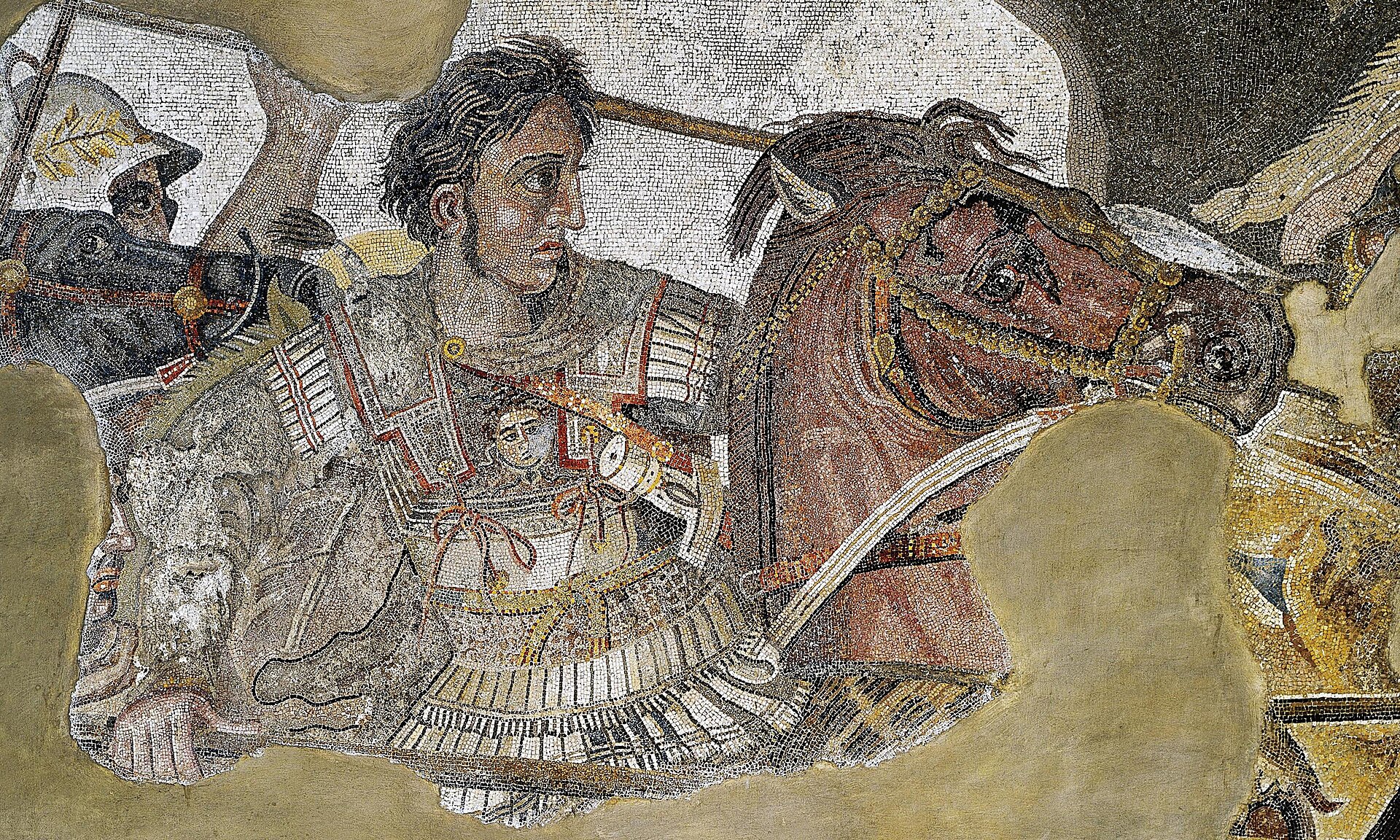
In the autumn of 333 BC, Alexander met the Persian king Darius in battle for the first time at Issus, in what is now southern Turkey. Darius commanded a vastly larger army on ground that actually favoured the Persians. But Alexander personally led the cavalry charge at the critical moment, driving straight for Darius himself. Darius, watching Alexander's forces tear through his line toward him, turned his chariot and fled. His army collapsed behind him. Left on the battlefield were Darius's wife, his two daughters, his mother Sisygambis, and the Persian treasury. Alexander treated them with courtesy, visiting the royal women and reassuring them of their safety.
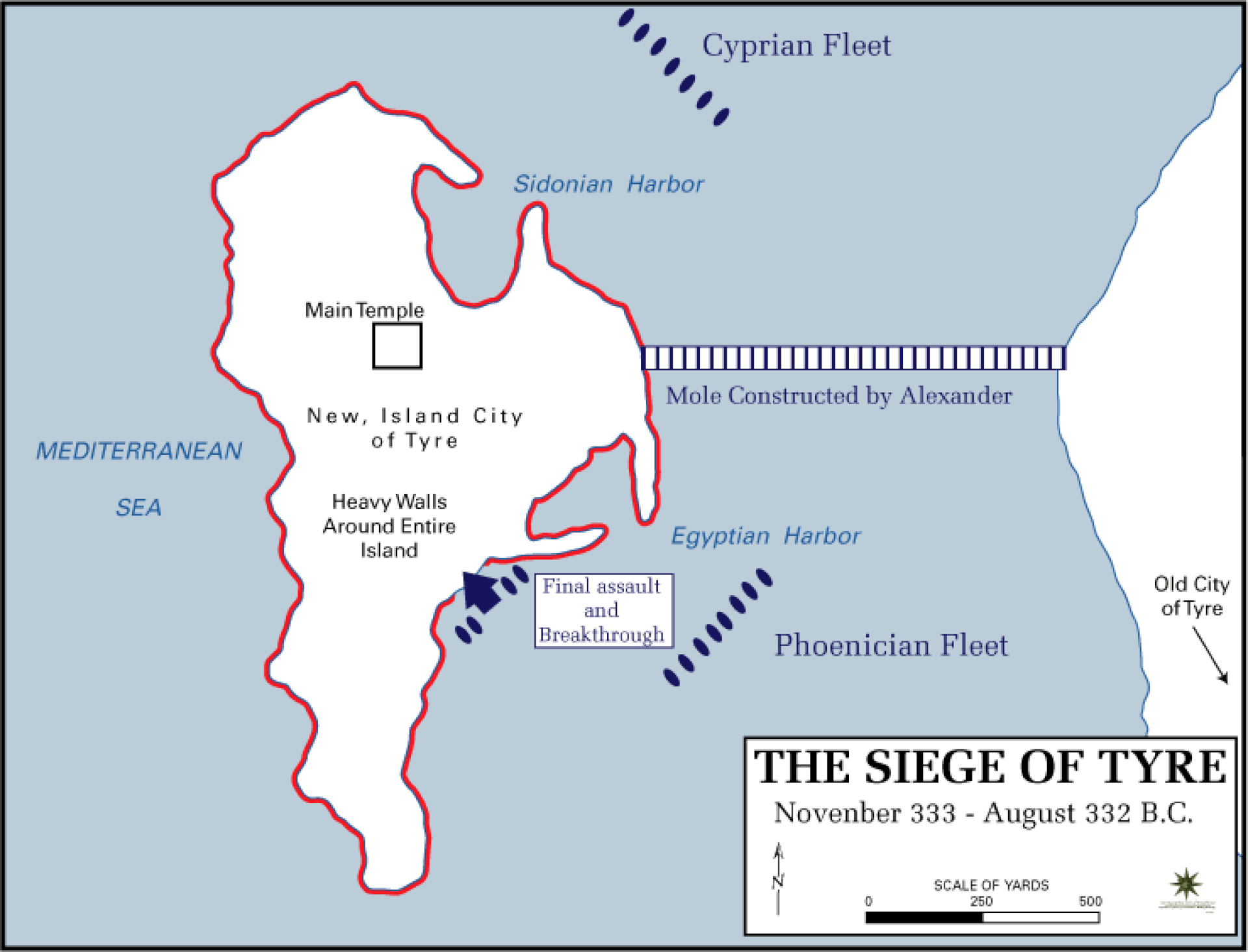
Darius sent peace offers: he would yield the lands already lost and pay a ransom of ten thousand talents in gold for his family. Alexander replied that there was no need to negotiate territorial divisions, since he was now king of Asia and all of it was his to dispose of as he chose. He then moved south through the Levant. The city of Tyre, a heavily fortified island off the Lebanese coast, refused to open its gates. Alexander besieged it for seven months, building a causeway from the shore to the island across open water. When the walls finally fell in 332 BC, the men of fighting age were killed and the women and children sold into slavery.
Egypt received him as a liberator from Persian rule. He made sacrifices to Egyptian gods, was crowned at Memphis, and made the extraordinary journey west across the desert to the oracle of Amun-Ra at the Siwa Oasis. The oracle declared him the son of the god Amun. Alexander took this seriously for the rest of his life, often referring to Zeus-Ammon as his true father. Before leaving Egypt he laid out the plans for a new city on the Mediterranean coast: Alexandria, which would become one of the great cities of the ancient world.
The decisive battle came in 331 BC at Gaugamela, in what is now northern Iraq. Darius had chosen flat open ground to maximise his advantage in numbers and war chariots fitted with scythe-blades on the wheels designed to shred Macedonian formations. He had an army that outnumbered Alexander's by a significant margin. What he could not overcome was the Macedonian phalanx: a formation of soldiers armed with the sarissa, a spear about six metres long, trained to an extraordinary standard by Philip and now wielded by Alexander with lethal tactical intelligence.
Alexander arranged a double phalanx with the centre advancing at an angle, which parted when the Persian scythe-chariots bore down and then reformed around them. He watched for the gap that his angled advance created in the Persian line, then drove his companion cavalry straight through it, heading directly for Darius. The Persian king turned and fled for the second time. His army disintegrated. Alexander captured Babylon, then Susa, then Persepolis, the ceremonial heart of the Persian empire.
At Persepolis, Alexander's troops looted the city for several days. During his five months there, a fire broke out in the palace of the old Persian king Xerxes and spread through the city. Whether it was a drunken accident or a deliberate act of vengeance for Xerxes's burning of Athens a hundred and fifty years earlier is debated; the ancient sources suggest a companion of Alexander's, a hetaera named Thaïs, may have instigated it. Alexander reportedly regretted it almost immediately, ordering his men to fight the flames, but the city was already burning.
Darius fled east but never reached safety. His own Bactrian governor Bessus had him stabbed and left dying by the roadside, then declared himself the new Persian king. Alexander found Darius's body, gave him a royal funeral, and claimed Darius had named him as his successor. He then spent two years hunting Bessus through the territories that are now Afghanistan and Central Asia, founding cities as he went, including one in what is now Kandahar and another at the furthest reach of the old Persian empire in modern Tajikistan.
The deeper Alexander pushed into Central Asia, the more his campaign changed character. Bessus was eventually betrayed and executed in 329 BC, but a guerrilla war erupted in Sogdiana under a local leader called Spitamenes, who fought Alexander for two years before being killed by his own men. During this grinding campaign, the tensions within Alexander's army and his own court began to crack open.
Alexander had been adopting Persian customs at court: Persian dress, Persian ceremonies, and in particular the practice of proskynesis, a gesture of deep obeisance that Persians offered to their king and that Greeks reserved for the gods. His Macedonian officers found it deeply offensive. The conflict came to a head one night in Samarkand, during a drunken banquet, when his old officer Cleitus, the same man who had saved Alexander's life at Granicus, accused him of abandoning Macedonian values and favouring Persian flattery. Alexander picked up a spear and killed him. He was struck by immediate remorse, reportedly lying in his tent for three days refusing food.
A conspiracy among his own royal pages was uncovered later in the Central Asian campaign. His court historian, Callisthenes, was implicated and arrested. He was tortured and likely died soon after. The men who had once been his schoolmates at Mieza were becoming afraid of him.
In the winter of 327 BC, Alexander turned toward India, the land his tutor Aristotle had written about and that no Greek army had ever penetrated. He fought his way through the mountain passes of what is now Pakistan, taking strongholds at Massaga and Aornos, sustaining serious wounds at both. When he crossed the Indus, the local king Omphis of Taxila submitted and became an ally.
The decisive battle in India came at the River Hydaspes in 326 BC, against a king called Porus, who commanded a battle line anchored by over two hundred war elephants. Alexander crossed the flooded river at night upstream from the main enemy position, took Porus's forces in the flank, and won after fierce fighting. Porus himself was wounded and captured. When Alexander asked him how he wished to be treated, Porus replied: like a king. Alexander was so impressed that he made him an ally, restored his kingdom, and added new territory to it.
His beloved horse Bucephalas died around this time, probably of wounds or old age, at roughly thirty years old. Alexander founded a city on the banks of the Hydaspes and named it Bucephala in his honour.
East of Porus's kingdom lay more kingdoms, more armies, and beyond them the vast Ganges plain with its enormous empires. Alexander's soldiers had been marching and fighting for eight years. At the Beas River in 326 BC, they refused to go further. His general Coenus spoke for the army: the men longed to see their parents, their wives and children, and their homeland. Alexander, according to the sources, withdrew to his tent for three days trying to change their minds. They did not change. He turned back.
The return journey was nearly as costly as any of the battles. Alexander led part of his force through the territory of a people called the Mallians, besieging their citadel. During the assault, he jumped alone over the wall into the enemy stronghold. His bodyguards scrambled after him in panic. An arrow drove through his armour and into his lung. He nearly died there, in an anonymous fort at the edge of India, before his men broke through the walls to reach him.
He sent part of his army home through Iran under his general Craterus, and commissioned his admiral Nearchus to explore the Persian Gulf coast with a fleet. He himself led the remaining force through the Gedrosian Desert in what is now southern Iran and Pakistan, a route of terrible difficulty where thousands of soldiers died of thirst and heat before reaching Susa in 324 BC.
Back in Persia, Alexander found that governors and military commanders had been misbehaving badly in his absence, apparently assuming he would never return. He executed several of them. He announced that he would send his veteran and disabled soldiers home to Macedon, an act of generosity that his army somehow heard as a threat. They mutinied at the city of Opis, accusing him of abandoning Macedonian values. After three days of standoff, Alexander responded by replacing Macedonian officers with Persians. The Macedonians quickly backed down and begged forgiveness. He reconciled with them over a banquet of several thousand men.
Alexander held a mass wedding at Susa in which he and his senior officers married Persian noblewomen, a ceremony designed to create a new Macedonian-Persian ruling class. He himself married Stateira, a daughter of Darius, and Parysatis, a princess of the other royal line. He was already married to Roxana, the Bactrian noblewoman he had wed in 327 BC. Most of the officers' Persian marriages did not outlast the year.
At Ecbatana, in what is now western Iran, Alexander's closest friend Hephaestion fell ill and died. They had been together since their schooldays at Mieza; ancient writers compared them to Achilles and Patroclus. Hephaestion had commanded troops, acted as diplomat, and was the one person who seems to have known Alexander entirely. His death devastated Alexander in a way that nothing else had. Alexander ordered an enormous funeral pyre constructed in Babylon, and decreed public mourning across the empire.
The ancient sources are clear that Alexander never fully recovered from this loss. He began to drink more heavily. He showed signs of increasing paranoia. He executed the guardians of Cyrus the Great's tomb at Pasargadae for allowing it to fall into disrepair. He planned a vast new campaign, an invasion of Arabia, and spent his final months in Babylon making preparations.
On either the tenth or eleventh of June, 323 BC, Alexander died in the palace of Nebuchadnezzar in Babylon. He was thirty-two years old. He had reigned for thirteen years, and in those years he had marched his army across more than thirty thousand kilometres of territory, fighting through Greece, Egypt, Persia, Central Asia, and India without losing a single battle.
The accounts of his final days divide into two versions. In one, he spent the night drinking with his admiral Nearchus and a companion called Medius, developed a fever that worsened over twelve days, and finally fell silent. His common soldiers, anxious for news, were permitted to file past him in his last hours; he was no longer able to speak and could only raise his hand slightly to acknowledge them. In the other account, he drank a massive bowl of unmixed wine in honour of the hero Heracles, then spent eleven days in declining agony without a fever before dying.
Whether the cause was typhoid, poisoning, excessive drinking, or the accumulated damage of years of wounds and campaigning, his doctors could not save him. Ancient theories of poisoning pointed to his former regent Antipater as the organiser of a conspiracy, but the most likely explanation is simpler and sadder: a body worn out by a decade of near-continuous warfare, heavy drinking, serious wounds in the chest and lung, and grief.
When he was asked on his deathbed to whom he left his kingdom, the accounts give his answer as "to the strongest." He had no legitimate heir yet living. His wife Roxana was pregnant; the child would be born after his death. His generals, the men who had been his Companions since boyhood, almost immediately began competing to inherit his power, and within forty years the single empire he had built was shattered into warring kingdoms.
The disintegration of Alexander's empire was swift and violent. His son, born after his death, was eventually murdered. His generals, known as the Successors, fought one another for decades. The empire split into three main blocs: Ptolemaic Egypt, the Seleucid kingdom covering Persia and the Near East, and Macedonian Greece. But the cultural transformation Alexander had set in motion could not be undone.
The Greek language spread across the entire conquered territory and became the common tongue of commerce, philosophy, and diplomacy from the Mediterranean to the borders of India. This common Greek dialect, known as the koine, became the language in which the New Testament was written, and it remained the dominant language of the Byzantine Empire until that empire's collapse in the fifteenth century. The culture and architecture of a dozen different peoples fused with Greek forms to produce the Hellenistic world, which in turn became the foundation of Roman and then Western civilisation.
In the territories closest to India, the fusion went deepest. Greek artistic forms blended with Buddhist thought and iconography in the region of Gandhara, producing Greco-Buddhist art and, eventually, some of the first figurative images of the Buddha himself, which scholars believe were modelled on Greek statues of Apollo. A Greek king in the Punjab, Menander the First, converted to Buddhism and was celebrated in Buddhist literature for centuries. Alexander's march had seeded a cultural cross-pollination that no army could have planned.
He founded more than twenty cities bearing his name, of which Alexandria in Egypt became the greatest: a centre of science, philosophy, and trade that would house the most famous library in the ancient world. His campaigns generated the first detailed Greek accounts of Persia, Afghanistan, India, and the sea routes of the Indian Ocean. His chroniclers mapped the known world for the Greeks in ways no traveller had before.
The Roman generals who came after him could not stop measuring themselves against him. Pompey adopted his hairstyle and searched the east for his old cloak. Julius Caesar, seeing a statue of Alexander in Spain, wept that he had achieved so little at an age by which Alexander had conquered the world. The emperor Caracalla imitated him with an obsessiveness that curdled into madness. Napoleon, when asked whether he preferred Alexander or Caesar, placed Alexander first, citing the Asian campaign.
After the Bible, the text known as the Alexander Romance, which collected the legends of his life into a sprawling narrative, was the most widely read piece of literature in medieval Europe. It was translated into almost every European language and into every major language of the Islamic world, going through well over a hundred versions and revisions across a thousand years. In some of those versions he was a prophet. In others, a philosopher-king searching for immortality. In the Greek seafaring tradition, a mermaid was said to haunt the waters asking sailors whether King Alexander lived, and the only safe answer was: he lives, and rules the world.
What the sources agree on is this: he fought from the front, shared his soldiers' hardships, never lost a battle despite usually being outnumbered, and drove himself with a ferocity that ultimately destroyed him. The Gordian Knot, the Granicus, Issus, Gaugamela, the walls at the Mallian citadel with an arrow in his lung: these were not the acts of a man managing an empire from a distance. He led the charge himself, every time. That habit is what made him and what killed him. He was thirty-two years old, and he had run out of world to conquer before he ran out of the desire to conquer it.
Image: Wikimedia Commons contributor, Public domain · AI-narrated · Drawn from Wikipedia · CC BY-SA 4.0