

Transcript
On 29 May 1453, the last ruler of the Roman Empire tore off his purple regalia and threw himself into the fighting. Constantine the Eleventh Palaiologos was never seen alive again. The great walls of Constantinople had finally been breached after a two-month siege, and the emperor chose to die with his city rather than surrender it. What ended that morning was not merely a medieval kingdom. It was a continuous thread of Roman governance stretching back more than fifteen hundred years, through fifty generations of emperors, from Augustus to Constantine, from Justinian to Basil, from the hills of Rome to the shores of the Bosphorus.
That thread is the subject of this story. The Byzantine Empire is the name historians give to the eastern half of the Roman Empire, which survived the collapse of the western half in 476 and endured for nearly another thousand years. Centred on the great city of Constantinople, founded on the site of the ancient Greek town of Byzantium, it was the wealthiest, most administratively sophisticated state in Europe for most of its existence. Its people called themselves Romans. Its emperors ruled in an unbroken line. And its fall, when it finally came, was one of the hinge moments of world history.
The story begins not with a sudden break but with a slow separation. During the third century, the Roman Empire was battered from every direction: Germanic peoples pressed across the Rhine and Danube, Persian armies raided the east, and dozens of would-be emperors rose and fell in rapid succession. The old system of government, built by Augustus for a different world, was cracking under the strain. A new structure was needed, and in 285 the emperor Diocletian provided it.
Diocletian's solution was the tetrarchy: rule by four. He appointed a co-emperor and each of them adopted a junior colleague, creating two senior rulers and two deputies, dividing the empire's vast administrative burden between them. It was a practical answer to an impossible problem, and it worked, for a while. But when Diocletian abdicated in 305, the system collapsed into civil war, and it was left to one man, Constantine, to put the empire back together under a single hand.
Constantine did more than reunite the empire. In 330 he moved its centre of gravity entirely, founding a new capital on the site of the Greek city of Byzantium. He called it Constantinople, the city of Constantine, and positioned it with extraordinary strategic intelligence: it sat astride the trade routes between Europe and Asia, it could be defended by sea on three sides, and it was close enough to both the Danube frontier and the Persian east to serve as a command post for either. The historian J. B. Bury wrote that its foundation inaugurated a permanent division between the eastern and western halves of the empire that would affect the whole subsequent history of Europe.
Constantine also transformed the empire's religious life. He did not make Christianity the only permitted faith, but he made it the favoured one: Christian clergy were exempted from taxation, Christians were preferred for administrative posts, and bishops were entrusted with judicial responsibilities. He convened the First Council of Nicaea to settle doctrinal disputes, establishing the principle that emperors summoned church councils rather than resolved theology themselves. The gold coin he introduced, the solidus, would remain a trusted currency for seven centuries. Under Constantine, the empire recovered its military strength and enjoyed a period of genuine prosperity.
When the emperor Theodosius the First died in 395, he was the last man ever to rule the entire Roman Empire. He left the eastern half to his son Arcadius and the western half to his younger son Honorius. The division was meant to be administrative, not permanent. But the two halves never came back together. Through the fifth century, wave after wave of invading peoples overran the west: Visigoths, Vandals, Huns, and Ostrogoths carved it into fragments. The east watched, and survived.
The east survived partly because of money and partly because of walls. Theodosius the Second reinforced Constantinople's fortifications to a degree that made the city almost impregnable. To keep the Hunnic king Attila away, he paid him substantial quantities of gold in annual tribute. When Attila died in 453 and his empire dissolved, Constantinople simply absorbed the remaining Huns as mercenaries. The western empire collapsed in 476, when a Germanic general deposed its last puppet emperor. The east barely paused. Its treasury was full, its walls were intact, and its institutions were functioning.
The early decades of the sixth century brought one of the most consequential reigns in the empire's history. Justinian the First, who took power in 527, was the son of an Illyrian peasant, raised by his uncle, the emperor Justin the First. He had the temperament of a man who believed the Roman Empire should look like it had under Augustus, and the energy to try to make it so. Within five years of taking the throne he had survived a catastrophic urban revolt, the Nika riots of 532, in which thirty thousand people died in Constantinople's hippodrome, and had used the political capital of that victory to begin something extraordinary: the reconquest of the lost western provinces.
The general Belisarius, one of the great commanders of the ancient world, led the first campaign in 533, sailing with a relatively small force to North Africa, where the Vandals had ruled since 429. The Vandal kingdom fell with surprising speed. Two years later Belisarius landed in Sicily, and then drove north through Italy. By 540 he had captured Ravenna, the Ostrogothic capital, after successful sieges of Naples and Rome. For the first time in decades, Italy was Roman again.
Read full transcript (35 more paragraphs)
The Gothic wars in Italy proved far harder to finish than to begin. The Ostrogoths regrouped under a determined king named Totila, who recaptured Rome in December 546. Belisarius was recalled, and it was left to a new commander, a eunuch general named Narses, to complete the conquest. Narses arrived in 551 with an army of around thirty-five thousand men and broke Gothic resistance in two decisive battles. By 553 the Italian peninsula was back under imperial control, along with a strip of southern Spain acquired by helping a Visigothic rebel. Justinian had reconstructed something close to a Mediterranean empire.
Justinian's legal legacy was equally monumental. In 529 a commission he appointed produced the Corpus Juris Civilis, a systematic collection of Roman law that reorganised centuries of contradictory rulings into a coherent code. A companion volume, the Pandects, was completed in 533. A textbook, the Institutiones, was issued for law students. Together these works became the foundation of legal systems across Europe and are still studied in law schools today. Justinian also closed the ancient philosophical school in Athens in 529, marking the formal end of classical pagan intellectual life, and oversaw the construction of the Hagia Sophia, the Church of the Holy Wisdom, whose dome remained the largest in the world for nearly a thousand years.
Yet Justinian's empire was already under strain before he died. A series of devastating epidemics struck in the sixth and seventh centuries, reducing the population sharply. The Lombards invaded Italy almost immediately after his death in 565, and within a generation only a third of the peninsula remained in Byzantine hands. His successors struggled to hold what he had won, paying subsidies to the Avars on the Danube while fighting the Persians in the east. The emperor Maurice managed to stabilise both fronts, but his assassination by a mutinous general named Phocas in 602 triggered a catastrophe.
Phocas was a brutal and incompetent ruler, and the Persian king Khosrau used the murder of Maurice as a pretext to launch a massive war of reconquest. Persian armies swept through Syria, occupied Damascus and Jerusalem, and carried off the True Cross to their capital at Ctesiphon. They pushed deep into Asia Minor and eventually threatened Egypt. The empire was on the verge of collapse when, in 610, a general named Heraclius sailed from Carthage to Constantinople with an icon of Christ fixed to the prow of his ship, overthrew Phocas, and set about rebuilding from near-ruin.
Heraclius spent a decade reorganising the army and the treasury, then launched a counter-offensive that he framed explicitly as a holy war. By 627 he had destroyed the main Persian force at Nineveh, and in 629 he restored the True Cross to Jerusalem in a ceremony of extraordinary symbolism. But both empires had bled each other white. When Arab armies, newly unified under the banner of Islam, erupted out of Arabia in the 630s, they found neither Byzantium nor Persia able to resist them effectively. The Byzantines suffered a crushing defeat at the Battle of Yarmuk in 636. Within a few years, Syria, Palestine, and Egypt had all been lost. The empire's three richest provinces were gone.
The losses were staggering in material terms, but the cultural transformation was equally profound. Cities across Asia Minor shrank from major urban centres to small fortified settlements. Constantinople itself fell from perhaps half a million inhabitants to somewhere between forty thousand and seventy thousand. The free grain shipments from Egypt, which had fed the capital for centuries, ceased. In response, the empire invented a new system of governance: the themes, administrative districts each controlled by a military commander who held both civil and military authority and answered directly to the emperor. It was a leaner, harder, more militarised state, rebuilt around survival.
The Arab threat did not stop with the conquest of the eastern provinces. Arab fleets and armies raided deep into Asia Minor for decades, and between 674 and 678 Arab forces laid siege to Constantinople itself. The city was saved in part by Greek fire, an incendiary weapon sprayed from ships that could burn on water, and the Arabs eventually agreed to a thirty-year truce. But the raids continued, and the Balkans were simultaneously being settled by Slavic peoples pushing south, while a new power, the Bulgars, established a state just days' march from Constantinople. The empire that had once stretched from Spain to Mesopotamia was now a battered core, fighting for its life.
The eighth century opened with the empire still under Arab pressure, and it was in this context that one of the great internal controversies of Byzantine history erupted. In 726 the emperor Leo the Third, who had just repelled a massive Arab siege in 718, ordered the removal of the great golden icon of Christ above the ceremonial entrance to the imperial palace. Four years later he issued an edict making the destruction of religious images official policy throughout the empire. The iconoclast movement, as it became known, held that the veneration of images had crossed into idolatry. The response from monks, clergy, and much of the population was furious resistance.
The controversy consumed the empire for more than a century. Leo's son Constantine the Fifth pushed iconoclasm further, provoking revolts and persecuting those who defended images. The empress Irene, ruling as regent for her young son in the 780s, reversed the policy, and in 787 the Second Council of Nicaea formally affirmed that icons could be venerated. But the financial cost of Irene's policies was severe: she exempted monasteries from taxation at a moment when the army desperately needed funding, weakening both the military and the treasury. She was eventually deposed by her own finance minister, who took the throne as Nicephorus the First in 802.
Nicephorus was a capable reformer who tried to repair the damage, but he was killed fighting the Bulgarian king Krum in 811, in one of the worst military defeats the empire had suffered. His son and successor was severely wounded in the same battle and died within months. The Bulgars were becoming an existential threat, pressing to within striking distance of Constantinople. The crisis forced the new emperor Michael the First to recognise the western emperor Charlemagne as a legitimate ruler, abandoning the centuries-old fiction that the Roman Empire was one. The treaty of 811 was a watershed: from that point, no one seriously imagined the two halves of the old empire might be reunited.
The low point passed. From the mid-ninth century, under the emperors of the Macedonian dynasty, the empire entered its most brilliant period since Justinian. The Macedonian rulers, of Armenian origin, combined military aggression with careful financial management and a genuine commitment to law, culture, and the protection of small farmers against the great landowners. Cities grew. Trade flourished. The population rose. Byzantine art produced mosaics of extraordinary refinement, and ancient Greek texts were preserved and copied by scholars working at the imperial court.
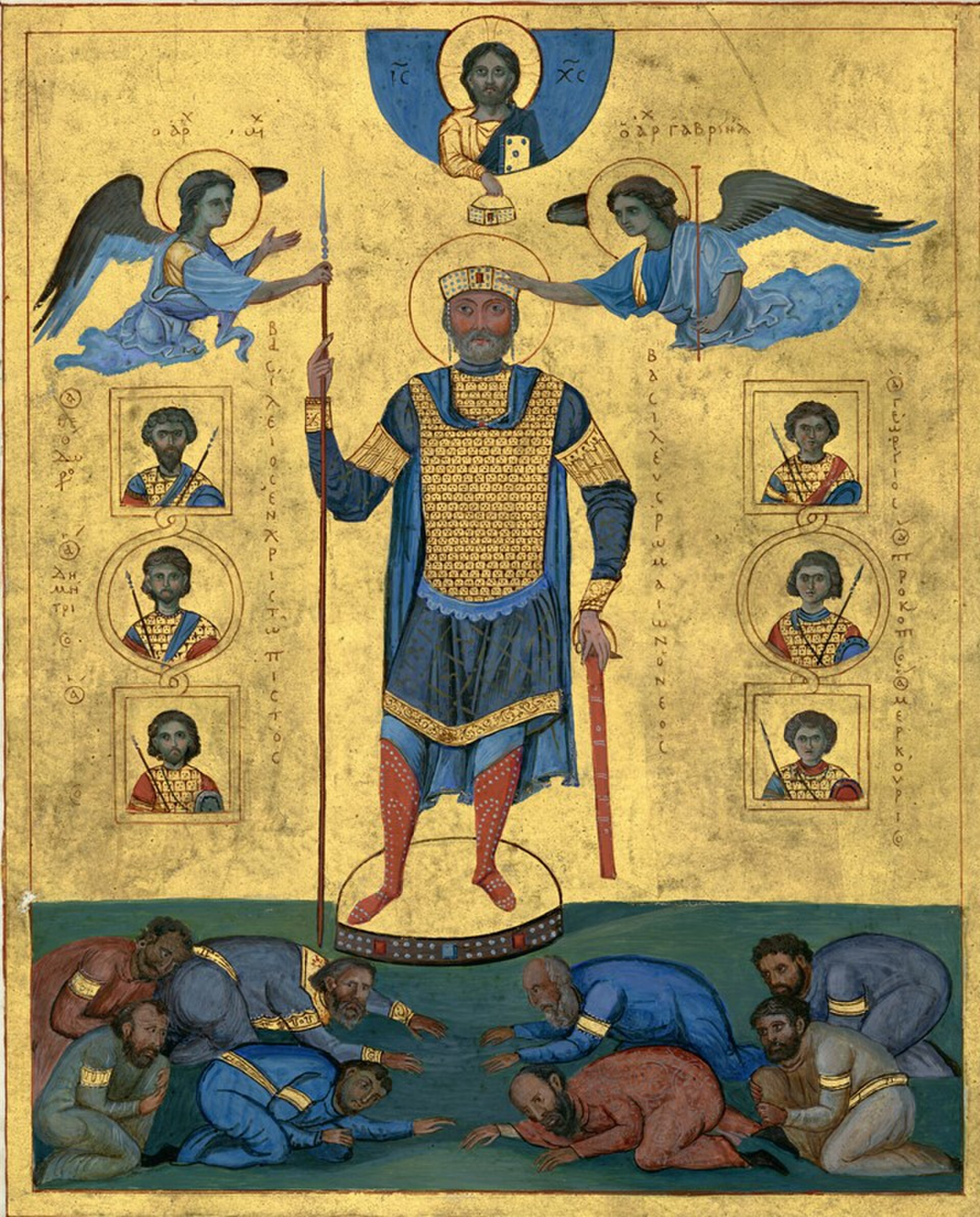
The Bulgarian threat, which had defined so much of the ninth century, was finally resolved in the most dramatic fashion imaginable. The emperor Basil the Second, who came to power in 976 and ruled for nearly fifty years, made the complete subjugation of Bulgaria his personal obsession. After a humiliating early defeat at the Gates of Trajan, he spent two decades in methodical annual campaigns, reducing Bulgarian fortresses one by one. At the Battle of Kleidion in 1014, he captured the bulk of the Bulgarian army. He blinded ninety-nine out of every hundred prisoners, leaving one eye to the hundredth man so that he could lead his compatriots home. When the Bulgarian tsar Samuil saw the broken column of blinded men returning, he died of shock. Bulgaria became part of the empire.
Basil's campaigns in the east were equally relentless. The empire pushed deep into Syria, with armies at one point threatening Jerusalem. The emirate of Aleppo became a vassal state. Byzantine missionaries converted the Serbs and Bulgarians to Orthodox Christianity, spreading the empire's cultural influence far beyond its borders. The relationship with the emerging state of Kiev Rus brought another enormous gain: around 988 the Rus prince Vladimir the Great converted to Orthodox Christianity and married the emperor Basil's sister Anna, cementing an alliance that would shape Russian civilisation for centuries. The Varangian Guard, an elite unit of Scandinavian warriors, became the emperor's personal bodyguard.
Under the Macedonian emperors, Constantinople became the largest and wealthiest city in the Christian world, with a population of around four hundred thousand. Its civil service managed an empire that traded silk and metalwork with Western Europe while projecting military power from Armenia to southern Italy. The emperor Leo the Sixth had already completed the codification of all Byzantine law into sixty volumes of Greek, a monumental achievement that shaped the empire's legal culture for centuries. Basil the Second died in 1025 with the empire at its greatest extent since Justinian, and a treasury full of gold. He had never married and left no plan for his succession.
The fifty years after Basil's death were a slow-motion disaster. His immediate successors had no military or political talent. The professional army was reduced and replaced with expensive mercenaries. The gold coinage was debased. The great theme system, which had provided the empire with a reliable base of soldier-farmers, was undermined. And in 1054 a theological quarrel that had been building for centuries finally broke into open rupture. On 16 July of that year, three papal legates walked into the Hagia Sophia during the Saturday liturgy and placed a bull of excommunication on the altar. The Christian church split in two: Eastern Orthodox and Western Catholic, divided ever after.
The military catastrophe that everyone feared arrived in the summer of 1071. The Seljuk Turks, a new power from Central Asia, had been probing across the eastern frontier for years. The emperor Romanos the Fourth led a massive army east to force a decisive battle. At Manzikert, in eastern Anatolia, he not only suffered a surprise defeat but was captured by the Turkish sultan Alp Arslan. Alp Arslan treated him with genuine courtesy and imposed no harsh terms. But back in Constantinople a coup overthrew Romanos in his absence. With no coherent imperial response, the Turks spread across the Anatolian plateau. By 1081 they controlled virtually the entire heartland of the empire, from Armenia to the shores of the Sea of Marmara, and had set up their capital at Nicaea, barely a hundred kilometres from Constantinople. The empire had lost its agricultural and demographic core in a decade.
The same year the Turks reached Nicaea, the Normans completed their own conquest in the west. They had been advancing through Byzantine southern Italy for two decades. Bari, the capital of the imperial province there, fell in April 1071, the same year as Manzikert. Two catastrophic losses in the same year, on opposite ends of the empire. The Byzantine presence in Italy, maintained for five centuries, was gone.
The dynasty that saved what remained was the Komnenoi. Alexios the First took power in 1081 and spent his entire reign in a desperate, ingenious effort to stabilise a shrinking empire. He faced Norman invasions from the west and Turkish pressure from the east simultaneously, paying some enemies off while fighting others, making alliances wherever he could find them. His most consequential move was to send envoys to Pope Urban the Second in 1095, describing the suffering of Christians under Muslim rule and requesting Western military assistance.
Urban saw the appeal as an opportunity to unite Western Christendom and extend papal authority. On 27 November 1095, at the Council of Clermont, he called for an armed pilgrimage to recover Jerusalem. The response was overwhelming. Alexios had expected a few thousand mercenaries. What arrived at Constantinople was an enormous, undisciplined mass of Western knights, foot soldiers, and camp followers, led by men who had their own ambitions in the east. Four of the eight principal leaders were Normans, including Bohemund of Taranto, who had previously fought against Byzantium. Alexios managed them carefully, requiring them to swear to return any conquered territories to the empire. The First Crusade captured Jerusalem in 1099, but the Crusader states that emerged were independent powers, not Byzantine provinces.
Alexios's son John the Second and his grandson Manuel the First continued the restoration with considerable success. John spent twenty-five years campaigning across Asia Minor, the Balkans, and the Holy Land, pushing the Turks back and restoring Byzantine authority over Cilicia and Antioch. He has been called the Byzantine Marcus Aurelius for the justice and moderation of his rule. Manuel extended the empire's influence still further, defeating Hungary, dominating the Crusader states, and sending fleets as far as Egypt. Under the Komnenoi, Constantinople remained the leading city of the Christian world in wealth and cultural prestige, and Byzantine art and architecture shaped the visual culture of Europe.
Yet the Komnenian restoration had limits. The empire was increasingly dependent on Italian merchants, especially the Venetians, who had been granted sweeping trading privileges and whose population in Constantinople numbered in the tens of thousands. Manuel suffered a significant defeat at the Battle of Myriokephalon in 1176 against the Turks, and when he died in 1180 leaving an eleven-year-old heir, the dynasty's careful work began to unravel. His successor Andronikos the First seized power in 1182, inciting a massacre of the Latin population of Constantinople that destroyed the commercial relationships the Komnenoi had cultivated. Andronikos was himself overthrown and killed in 1185. The dynasty of the Angeloi that followed presided over a catastrophic weakening of central authority, with revenues squandered, the army neglected, and Bulgaria breaking away to form a second independent Bulgarian empire in 1186.
The blow that nearly killed the empire did not come from the Turks or the Bulgars. It came from fellow Christians. In 1202 a Crusading army assembled in Venice, intending to attack Egypt. Unable to pay the Venetians for their fleet, they agreed instead to help Venice capture the Christian port of Zara on the Adriatic. Then a deposed Byzantine prince named Alexios Angelos arrived, promising to pay enormous sums and to reunite the Orthodox and Catholic churches if the Crusaders would restore him to his throne. The Venetian leader, the elderly but formidably ambitious Doge Enrico Dandolo, saw the opportunity. Pope Innocent the Third had explicitly forbidden any attack on Constantinople, but the fleet had already sailed.
When the Venetian fleet entered the waters of Constantinople in June 1203, the emperor Alexios the Third simply fled. The deposed prince was installed as Alexios the Fourth. But he could not deliver on his promises: the treasury was empty, and the population of Constantinople had no interest in church union with Rome. When he admitted in late November 1203 that he could not pay what he had promised, the Crusaders declared war. A courtier murdered him in January 1204, and the Crusaders prepared to take the city by force.
Constantinople fell to the Crusaders on 13 April 1204. For three days the city was subjected to pillage and massacre. Priceless icons, relics, and works of art accumulated over nine centuries were looted. A prostitute was reportedly installed on the Patriarchal throne. When Innocent heard what his Crusaders had done, he condemned them in the strongest terms, but the situation was beyond his control. Baldwin of Flanders was crowned Latin Emperor of a new Latin Empire of Constantinople. The Byzantine empire was carved up among the Crusade's leaders. The Roman Empire, in any meaningful sense, had been destroyed by its fellow Christians.
Three Byzantine successor states survived the catastrophe. The Empire of Nicaea, in western Asia Minor, proved the most resilient. Founded by the Laskarid dynasty, it maintained Byzantine administration and culture in exile for fifty-seven years, slowly rebuilding its strength while the Latin Empire in Constantinople weakened. In 1261, the Nicaean emperor Michael the Eighth Palaiologos retook Constantinople without a major battle, the Latin garrison having largely departed on a military expedition. The city was recovered. The empire was restored.
But the restoration was a shadow of what had come before. The city itself was badly damaged, its population a fraction of its former size, its economy hollowed out. Michael pulled troops from Asia Minor to campaign in the west, leaving the eastern frontier exposed to Turkish raiders. He forced the Church to submit to Rome to avoid another Western attack, a humiliation that his own people bitterly resented. His successors, Andronikos the Second and then Andronikos the Third, fought a damaging civil war from 1321 to 1328 that allowed the Ottoman Turks, a new and rising power, to consolidate their hold on the Anatolian interior and establish their capital at Bursa, barely a hundred kilometres from Constantinople.
A second civil war, from 1341 to 1347, proved even more destructive. When Andronikos the Third died in 1341 he left a six-year-old son, and the struggle over the regency became open warfare between the empire's wealthy landowners and its poorer citizens. The conflict lasted six years and devastated what remained of the empire's military capacity. The Serbian king Stefan Uroš the Fourth exploited the chaos to seize large portions of Macedonia, Thessaly, and Epirus. When the civil war ended with the victory of John Cantacuzenus in 1347, the empire he had won was a wreck. The mercenaries he had hired to fight the war promptly seized Gallipoli in 1354, giving the Ottomans their first foothold in Europe.
From the mid-fourteenth century, the Byzantine Empire's history is the history of a slow strangulation. The Ottomans advanced steadily through the Balkans, defeating the Serbs, subjugating Bulgaria, and surrounding Constantinople on the landward side. The Byzantine emperors made desperate appeals to the West for military aid, but Western rulers demanded the unification of the Orthodox and Catholic churches as a price for assistance. Church union was agreed in principle more than once, but the Orthodox clergy and population would not accept it, and the Western help never came in adequate quantity. A handful of Western soldiers arrived; the Ottomans continued to pick apart the remaining Byzantine territories one by one.
By the mid-fifteenth century, Constantinople stood alone. The surrounding countryside was Ottoman. The population of the city had collapsed to perhaps fifty thousand, and the urban fabric had fragmented into a scatter of villages separated by fields and ruins. The empire that Justinian had stretched from Spain to Mesopotamia, that Basil the Second had extended from Armenia to southern Italy, now consisted of a single city and a few scattered outposts.
On 2 April 1453, the Ottoman sultan Mehmed the Second brought an army of around eighty thousand men to the walls of Constantinople. The defending force numbered perhaps seven thousand, of whom two thousand were foreign volunteers. For nearly two months the defenders held the great Theodosian walls that had protected the city since the fifth century. The Ottomans brought enormous cannon to batter the walls, and the defenders repaired the breaches each night. The Byzantine emperor Constantine the Eleventh sent appeals in every direction. No relief came.
On the morning of 29 May 1453, the Ottoman forces broke through. Constantine the Eleventh tore off his imperial robes and threw himself into the fighting at the breach. He was never seen alive again. The city fell. The Roman Empire, which had begun with Augustus in 27 BC and had governed the Mediterranean world for fifteen centuries, was over. Mehmed the Second rode into the Hagia Sophia and had it converted to a mosque. He would call himself Caesar of Rome for the rest of his life.
The last embers took a few more years to die. The Despotate of the Morea, a small Byzantine territory in southern Greece ruled by brothers of the last emperor, surrendered to Mehmed in 1460. The Empire of Trebizond, a Black Sea state that had split from Byzantium in 1204 and survived as its own entity, held on until August 1461, when its emperor David surrendered the city after a month-long siege. The Principality of Theodoro in the Crimea lasted until 1475. With its fall, the last remnant of the Roman state was extinguished.
The empire left behind it an extraordinary legacy, though the people who had lived inside it never called it Byzantine. They called themselves Romans, and they were right to do so. The administrative continuity from Augustus to Constantine the Eleventh was unbroken. The legal code that Justinian compiled shaped the law of every European nation. The Greek scholarship preserved in Constantinople's libraries, transmitted to Italy in the decades around the fall, helped ignite the Renaissance. The Orthodox Christianity that Byzantine missionaries carried to Bulgaria, Serbia, Russia, and Georgia shaped the religious and cultural identity of half of Europe.
The Russian tsars claimed the Byzantine inheritance directly. Ivan the Third of Moscow married the niece of the last emperor and styled himself the successor to the Roman throne. His grandson Ivan the Fourth would be crowned the first tsar of all Russia, the word tsar itself a form of Caesar. The idea that Moscow was the third Rome, heir to Constantinople as Constantinople had been heir to the original city, animated Russian imperial identity until the revolution of 1917.
What the fall of Constantinople meant, in the end, was not the death of an idea but its dispersal. The Roman Empire had always been more a civilisational project than a territory: a claim that law, learning, and a certain vision of ordered society could be maintained against chaos. The Byzantines had maintained that claim for a thousand years after Rome itself fell, through plagues and conquests and civil wars and theological crises that would have destroyed a less resilient state. Constantine the Eleventh, dying at the walls in his imperial city, was the last in a line that stretched back to Augustus. He did not surrender. That, perhaps, is the one fact about the Byzantine Empire that its thousand years of history earned the right to say.
Image: Tataryn, CC BY-SA 3.0 · AI-narrated · Drawn from Wikipedia · CC BY-SA 4.0