

Transcript
On the morning of 15 March 44 BC, a man who had conquered most of western Europe, survived pirates, civil war, and desert battles, walked into a Senate meeting and sat down on a golden chair at the foot of a statue of his old rival, Pompey. He had been warned. He had refused a bodyguard. He had dismissed the omens. The senators gathered around him, and then the daggers came out. He was stabbed at least twenty-three times, and died at once.
That man was Julius Caesar, and Rome in his time was governed by a republic: a system in which elected magistrates, a powerful Senate of several hundred aristocrats, and popular assemblies all shared authority and checked one another. For five centuries this arrangement had held. Caesar, more than any single person, broke it apart. His name became the word for emperor in a dozen languages. Two thousand years later, the titles Kaiser and Tsar still carried his cognomen into the modern world.
He was born on 12 or 13 July 100 BC into the patrician clan of the Julii, an ancient but not especially powerful family. They claimed descent from the goddess Venus through a legendary ancestor, and that divine genealogy, however fanciful, was the kind of pedigree that meant something in Rome. The family's first consul had served over a century before Caesar was born, and his father rose no higher than a regional governorship before dying suddenly in 84 BC, when Caesar was about sixteen.
What shaped the young Caesar more than ancestry was crisis. The Rome of his boyhood was ripping itself apart. The general Sulla had just won a civil war, and Caesar found himself on the wrong side: his connection through his aunt to the defeated general Marius, and his betrothal to the daughter of Sulla's enemy Cinna, made him a target. Sulla ordered him to divorce his wife. Caesar refused. He went into hiding. His relatives among the Vestal Virgins eventually won him a pardon, but Sulla is said to have remarked that he saw many Mariuses in the boy.
With that danger past, Caesar left Italy to serve on the staff of a provincial governor in Asia. He travelled to the kingdom of Bithynia to collect a fleet. He served at the siege of Mytilene on the island of Lesbos, where he won the civic crown, a wreath awarded for saving a fellow citizen's life in battle. The crown's privileges were significant: the Senate was obliged to stand when its holder entered a room, and the holder could wear it at public occasions. Caesar never forgot the taste of that honour.
On his way to Rhodes to study rhetoric, Caesar was captured by pirates in the eastern Mediterranean. He was held for ransom and, according to Plutarch and Suetonius, paid his captors and then returned with a fleet to capture and execute them. Whether the story is embellished or not, its thrust fits the man: he treated the insult as a debt to be collected. His studies in oratory were soon interrupted when a new war with the kingdom of Pontus broke out around 75 BC, and Caesar reportedly collected troops at local expense and led them successfully against the enemy's forces.
Returning to Rome, he tried his hand at the law courts, prosecuting two corrupt former governors in succession. Both attempts failed or were blocked, but the effort built his reputation as a speaker. By 73 BC, while still abroad, he was co-opted into the college of pontiffs, a body of state priests, marking him as a man of serious future prospects. He was elected a military tribune for 71 BC, and used the post not to fight but to agitate for the restoration of rights to the people's tribunes that Sulla had stripped away.
The year 69 BC brought both a political advance and personal grief in the same season. Caesar was elected quaestor, a junior financial magistrate, which earned him a lifetime seat in the Senate. But before he left for his posting in southern Spain, his aunt Julia died, and then his wife Cornelia died shortly after giving birth to his only legitimate child, a daughter also named Julia. He gave public eulogies for both women. At his aunt's funeral, he displayed the images of Marius, which Sulla had banned, a political signal wrapped inside a family ritual. He then quickly remarried, taking Pompeia, a granddaughter of Sulla himself.
Through the 60s BC, Caesar spent lavishly and climbed steadily. As a curule aedile, one of the magistrates responsible for public buildings and games, he staged spectacles in 65 BC so extravagant they won him enormous popular support. He also restored the victory trophies of Marius that Sulla had taken down, a gesture that delighted the crowd and enraged his aristocratic opponents. Each move was calculated: Caesar was building a constituency among the Roman people at the same time as he was accumulating debt.
In 63 BC, he made the boldest bet of his early career, standing for the office of pontifex maximus, the highest religious official in Rome, head of the College of Pontiffs. His two opponents were far more senior men. Caesar reportedly told his mother on the morning of the vote that he would come home either as pontifex maximus or not at all, so deep were his debts if he lost. He won. No one has ever fully explained why, though Pompey's financial backing is one possibility. The victory gave Caesar a state residence in the Roman Forum and a platform of enormous prestige.
Read full transcript (31 more paragraphs)
That same year the city was convulsed by the Catilinarian conspiracy, a plot to overthrow the government by a disgruntled aristocrat. Caesar argued in the Senate against executing the arrested conspirators without trial, proposing life imprisonment instead. His opponent Cato, a strict republican senator who became Caesar's most persistent enemy, argued for execution and won the debate. The episode cemented a pattern: Caesar the pragmatist against Cato the absolutist, a tension that would run through the next two decades.
By 60 BC, Caesar had served as propraetor, a governor-ranked official, in southern Spain, where he fought hard enough to be acclaimed imperator by his troops and to clear his debts with plunder. He arrived back in Rome in the summer facing a choice: wait outside the city's sacred boundary to receive a triumph, or cross inside, give up his military command, and declare his candidacy for the consulship. Cato filibustered every attempt to let him do both. Caesar gave up the triumph and stood for consul.
He won the consulship for 59 BC, and immediately did something that changed Roman politics permanently. He reconciled the two most powerful men in Rome: Pompey, the great general whose eastern conquests had made him fabulously rich, and Crassus, the wealthiest man in the republic. The three formed what historians call the First Triumvirate, an informal private alliance with no legal standing but enough combined money, military prestige, and popular support to dominate the state.
Caesar's year as consul was a controlled collision between his agenda and the Senate's resistance. His land reform bill, designed to distribute public land to Pompey's veterans and the urban poor, was obstructed at every turn by his co-consul Bibulus and by Cato's filibustering. Caesar took it directly to the people's assembly, bypassing the Senate. When Bibulus threatened to veto the entire legislative year on religious grounds, the crowd broke his ceremonial rods of office. The bill passed. Bibulus retreated to his house and spent the rest of the year issuing religious edicts from indoors, the most ineffectual opposition in Roman political history.
Caesar also secured himself a military command: the provinces of Cisalpine Gaul and Illyricum, in what is now northern Italy and the Adriatic coast, were assigned to him for five years. The Senate then added Transalpine Gaul, the Roman province of southern France, to his portfolio. He left Rome in early 58 BC as governor of a substantial swath of the Roman world, with several legions at his disposal and an ambition that no province yet contained.
Gaul in 58 BC was not a single country but a patchwork of competing tribes stretching from the Rhine to the Atlantic, most of it beyond Roman control. Caesar spent the next nine years turning that patchwork into a Roman province. He wrote about every year of it, producing what became known as "The Gallic Wars", ten volumes of military dispatches dressed up as history, clear and direct and relentlessly self-serving. Students of Latin have been reading them for two thousand years.
The wars began with a migration. The Helvetii, a tribal confederation from what is now Switzerland, were moving through Roman territory in April 58 BC. Caesar built a wall to stop them near Geneva, raised two additional legions, and defeated them at the Battle of Bibracte, forcing them home. He was then drawn north by requests from allied Gallic tribes for help against Ariovistus, a Germanic king who had crossed the Rhine. Caesar defeated him at the Battle of Vosges, marking the Rhine as a Roman frontier.
The following years saw Caesar push into the north and west, suppressing the Belgae tribes near what is now Belgium and the Veneti along the Atlantic coast of Brittany. To demonstrate Rome's reach, he built a bridge across the Rhine, a feat of engineering that took his soldiers just ten days and that he demolished once he had crossed and returned. He then led two expeditions into Britain in 55 and 54 BC, the first Roman general to do so, though both times he withdrew without permanent conquest. Britain was, to Romans, an island of legend: Caesar made it real.
The gravest test came in 52 BC. A young chieftain named Vercingetorix united most of central Gaul in a coordinated uprising, cutting Caesar's supply lines and drawing him into a costly siege at Gergovia that Caesar lost outright. He fell back, regrouped, and pursued Vercingetorix to the hilltop fortress of Alesia. There Caesar did something audacious: he besieged the fortress with one wall facing inward and built a second wall facing outward, trapping Vercingetorix inside while holding off a relief army of hundreds of thousands outside. His outnumbered forces held both lines simultaneously. Vercingetorix surrendered. It was arguably the most remarkable feat of field engineering in ancient history.
Caesar spent two more years mopping up remaining resistance across Gaul. By 51 BC the conquest was complete. He had added to the Roman world a territory roughly the size of modern France, Belgium, and Switzerland combined. His veterans were battle-hardened, devoted, and paid from Gallic plunder. His dispatches had kept him famous in Rome through nearly a decade of absence. But the alliance that had launched him was now collapsing.
The death of Crassus at the Battle of Carrhae in 53 BC, destroyed by the Parthians in the Syrian desert, removed the third weight from the balance. Without him, the alliance between Caesar and Pompey had no mediating centre. By 50 BC, Pompey had aligned himself with the Senate conservatives around Cato. Caesar's command was due to expire, and the Senate moved to recall him. Caesar's enemies made clear they intended to prosecute him the moment he lost the immunity that came with holding a command.
On 7 January 49 BC, the Senate issued its final decree, the ancient republic's version of emergency powers, against Caesar. His supporting tribunes were driven from Rome. Caesar's renewed offer that both he and Pompey disarm received 370 votes in favour and 22 against, but was killed when a hostile consul dissolved the session before a vote could be ratified. The door, quite deliberately, had been closed.
Around 10 or 11 January 49 BC, Caesar led a single veteran legion across the Rubicon, the small river that marked the legal boundary between his province and Italy proper. Roman law forbade a general from crossing that line with troops under arms. To cross it was to declare war on the state. Caesar crossed it. Plutarch and Suetonius record that he quoted the Greek playwright Menander as he did so: "let the die be cast." It was the most consequential step taken on Italian soil since Hannibal crossed the Alps, and Caesar took it knowing exactly what it meant.
Pompey and the Senate fled south, then across the sea to Greece, abandoning Rome without a fight. Caesar paused, negotiated, and when talks collapsed, pushed south. He seized the treasury over a tribune's veto, demonstrating with one act that his professed defence of tribunician rights had always been a justification, not a principle. He left a lieutenant in charge of Italy and turned west to destroy Pompey's armies in Spain before his rival could use them. Within months, three of Pompey's legions in Spain had surrendered.
The decisive confrontation came on 9 August 48 BC at Pharsalus in Greece. Caesar had crossed the Adriatic in winter, besieged Pompey at Dyrrhachium, been broken out and forced to retreat, then wheeled and caught Pompey in open battle. Pompey's forces outnumbered him substantially; Caesar won anyway, routing the senatorial army in a single afternoon. Pompey fled for Egypt. Cicero and Brutus begged Caesar's pardon and received it. Caesar's policy of clemency toward defeated enemies was a deliberate political strategy, and it worked: many former opponents became his men.
Pompey was killed on the Egyptian shore before Caesar arrived, murdered by agents of the young pharaoh. Caesar reached Alexandria on 2 October 48 BC, three days after the killing, and found himself trapped there by seasonal winds. He decided to arbitrate a civil war between the pharaoh and his sister Cleopatra, who was also his co-regent wife. Caesar sided with Cleopatra, began an affair with her, and survived a months-long siege in the royal quarter until reinforcements arrived from the east in March 47 BC. He then defeated the pharaoh's forces at the Battle of the Nile and installed Cleopatra as ruler. Their victory procession on the Nile was as much a celebration of their personal alliance as a military parade.
He lingered in Egypt until June or July 47 BC. In late June, Cleopatra gave birth to a son, called Caesarion. Caesar left for the east, where a king named Pharnaces had swept through Pontus in northern Anatolia while Caesar was occupied in Egypt. Caesar engaged him at Zela and annihilated his forces so quickly that he wrote to Rome: veni, vidi, vici. I came, I saw, I conquered. The phrase was not just a boast; it was a calculated insult to Pompey, who had spent years in the same region achieving what Caesar wrapped up in a matter of days.
He returned to Italy to find his deputy Mark Antony had mishandled everything: riots over debt relief had been suppressed by killing protesters, a mutiny had paralysed his veteran legions, and the remaining republican forces in North Africa, under Cato, were regrouping with local allies. Caesar demoted Antony, pacified the mutineers without violence, and left for Africa on 25 December 47 BC.
The African campaign was the hardest of the civil war. His landing was chaotic. He was defeated at Ruspina in January 46 BC by his former lieutenant Labienus and spent weeks cautiously rebuilding. He eventually manoeuvred the republican forces into a corner at Thapsus, where his troops attacked prematurely on 6 April 46 BC and slaughtered their opponents without mercy. When Caesar marched to Utica, where Cato was in command, he arrived to find that Cato had killed himself rather than accept Caesar's pardon. It was the one death Caesar could not have planned away, and the one that most haunted his reputation.
Caesar returned to Rome in late September 46 BC and celebrated four triumphs in succession, supposedly over foreign enemies: Gaul, Egypt, Pontus, and Africa. He led his captives before the crowd, including Vercingetorix, who was executed, and Cleopatra's younger sister Arsinoe. The spectacle was vast, but according to the historian Appian, when he also displayed pictures of Romans he had defeated in the civil wars, the crowd fell silent with dismay. He had won everything. Winning was beginning to cost him.
One final campaign remained. The Spanish provinces had revolted, and two of Pompey's sons had joined the resistance with Labienus. At Munda on 17 March 45 BC, Caesar fought the most dangerous battle of his life: outnumbered on difficult ground, he was nearly broken before his veterans held. It was, he reportedly said, the first time he had fought for his life rather than for victory. Labienus died on the field. The last republican army was destroyed. The civil wars were over.
Back in Rome by October 45 BC, Caesar now held power with no remaining military challenge. He had been appointed dictator repeatedly since 49 BC, each appointment longer than the last. In February 44 BC, he accepted the dictatorship for life, making permanent what everyone had long suspected was permanent anyway. He wore royal dress. His portrait appeared on coins, the first living Roman so honoured. The Senate month of Quintilis, in which he was born, was renamed Julius, the month we still call July.
He reformed the calendar, replacing Rome's old lunar system with a solar one of three hundred and sixty-five days and a leap year: the Julian calendar, which the Western world used for the next sixteen centuries. He expanded the Senate from six hundred to nine hundred members. He founded new colonies on the sites of destroyed Carthage and Corinth. He reduced the grain dole by tightening its eligibility. He extended citizenship to communities in Spain and northern Italy. The reforms were real and many were lasting, but they were made by one man's fiat, with the Senate consulted as a formality.
The contradiction at the heart of Caesar's rule was one he never resolved. He had fought the civil war in the name of the Roman people's liberty and the tribunes' rights. He had won. And then he deposed two tribunes who tried to block a crowd from calling him king, claiming they had insulted his honour. The crowd that had cheered the tribunes as guardians of the people's freedom noticed the contradiction. Graffiti appeared in the city condemning Caesar as a tyrant and asking where a Brutus was to remove him.
The conspiracy had been forming since at least the summer of 45 BC. By February 44 BC, around sixty senators had joined it. They came from both sides of the civil war: former Pompeians who had never accepted Caesar, but also Caesarians who had fought beside him and now believed his rule had become intolerable. Their leaders were Cassius, a sharp-minded former Pompeian, and Brutus, who was Caesar's close associate and who claimed descent from the ancient founder of the republic. Brutus was the conspirators' moral argument made flesh: if even he turned against Caesar, the killing could be called liberation rather than murder.
The date they chose was 15 March 44 BC, the Ides of March, three days before Caesar was due to depart for a years-long campaign against Parthia. They chose a Senate meeting because only there would no one else be armed. Word of the plot had leaked in fragments, and various stories describe Caesar being warned, being urged by his wife not to attend, receiving a note he never read. He went anyway. He dismissed his Spanish bodyguard. He sat down on his golden chair in the Curia of Pompey, directly beneath the statue of the man he had defeated at Pharsalus.
The conspirators crowded around him under the pretence of presenting a petition. One of them pulled down his toga from his shoulder: the signal. The daggers came out from beneath senatorial robes. Caesar was stabbed at least twenty-three times. Whether he died in silence, as Suetonius has it, or whether he looked at Brutus and said, kai su teknon, "you too, child," the ancient sources cannot agree. What they agree on is the end: he fell at the foot of Pompey's statue, and died at once.
The assassins seized the Capitoline hill and called a public meeting. The crowd received them coldly. Mark Antony, the surviving consul, manoeuvred the Senate into a position where Caesar was neither declared a tyrant nor his killers punished. At Caesar's funeral, Antony read the will to the crowd and displayed the body. The public erupted; the assassins fled the city. A comet that appeared in the sky that year was taken by the Romans as a sign of Caesar's divinity.
The will named as principal heir one Gaius Octavius, Caesar's eighteen-year-old great-nephew then studying at Apollonia across the Adriatic. The young man came back to Rome, accepted the inheritance and the name, and began a career that would consume the next fourteen years in another series of civil wars. He defeated the assassins at the Battle of Philippi. He broke with Antony. He won the final war at Actium in 31 BC. The Senate declared Caesar a god in January 42 BC. A temple was begun on the site where Caesar's body had been cremated in the Roman Forum; the altar from that temple still stands, and flowers are left there on 15 March each year.
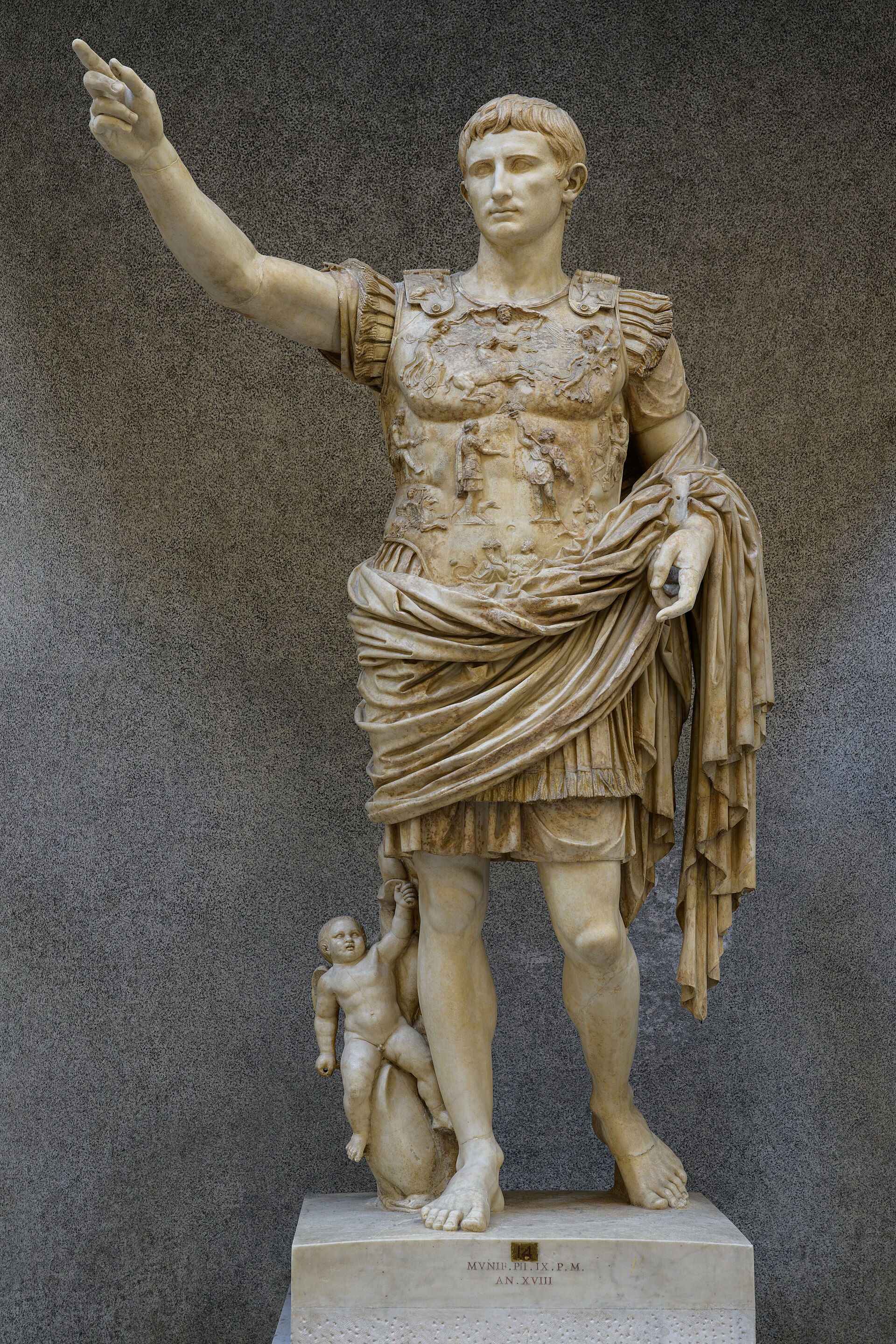
Caesar's heir, now the emperor Augustus, built a version of Rome that looked like a restored republic and functioned as a monarchy. He spread the cult of his adopted father as the foundation of his own authority. Caesar's name became the title for every ruler who followed: the Caesars of Rome, the Kaisers of Germany, the Tsars of Russia. The last ruler to hold a throne under that name was dethroned in 1946. For roughly two thousand years, somewhere in the world, a head of state bore the cognomen of the man who was stabbed twenty-three times in a Senate meeting and did not survive to see what he had started.
He had set out to win a consulship, then a triumph, then a command, then a war, then another war, then the world. He reformed the calendar, wrote his own history, pardoned his enemies, and named himself dictator for life. And then his friends killed him for it, in the house of the man he had beaten, beneath that man's statue, on the morning he chose not to be afraid.
Image: Ángel M. Felicísimo from Mérida, España, Public domain · AI-narrated · Drawn from Wikipedia · CC BY-SA 4.0