

Photo: Chief Photographer's Mate (CPHoM) Robert F. Sargent · Commons · Public domain · Cropped & Resized
Transcript
Nearly 160,000 men crossed the English Channel on a single day. That number alone should stop you. Not a week's worth of reinforcement, not a phased build-up across a month. One day. And behind that number sat years of deception, weeks of sleepless planning, and a weather forecast delivered by one RAF officer on the evening of 4 June 1944 that would decide whether the invasion of Nazi-occupied Europe would happen at all.
We are in the summer of 1944, and the Western Allies, principally Britain, the United States, and Canada, have spent nearly five years at war with Germany. The Soviet Union has been fighting on the Eastern Front since 1941, absorbing catastrophic losses. Soviet leader Joseph Stalin had been pressing his allies since 1942 for a second front in western Europe, somewhere the Germans would have to split their attention and their armies. That front had been promised, then delayed, then promised again. By late 1943, at a conference in Tehran, Roosevelt and Churchill finally gave Stalin a firm date: May 1944.
The target was the coast of Normandy in northern France. Four other sites had been considered: Brittany, the Cotentin Peninsula, the Pas-de-Calais, and Normandy itself. The Pas-de-Calais was the obvious choice, the shortest crossing from England, and the Germans knew it, which is why it was the most heavily fortified stretch of coastline in Europe. Normandy offered something better than the obvious: a broad front, access to the port at Cherbourg, and the possibility of driving overland toward Paris. Normandy it would be.
Before a single soldier boarded a landing craft, the Allies fought an invisible war of lies. The operation to mislead Germany about the invasion's timing and location was called Operation Bodyguard, and it was extraordinarily elaborate. Its most important strand, Fortitude South, created a fictitious army group in Kent and Sussex, supposedly commanded by the American general George Patton, and fed the Germans false radio traffic suggesting the real blow would fall at Calais. Patton remained stationed in England until early July, keeping the fiction alive even after D-Day itself.
On the night before the landings, the deception continued. A small group of special forces dropped dummy paratroopers over Le Havre and Isigny to simulate an airborne landing in the wrong place. Meanwhile, aircraft from No. 617 Squadron dropped strips of metal foil that produced radar returns mimicking a naval convoy heading toward Le Havre, bolstered by small vessels towing barrage balloons. A similar phantom fleet was conjured near Boulogne. German radar operators saw what looked like two invasion fleets, neither of them real.
The French Resistance played its own part. Through coded messages broadcast by the BBC, resistance groups across France received instructions to execute four sabotage plans on D-Day and the days following. Railway lines were cut in more than five hundred places across the southeast of France on 6 June alone. Fifty-two locomotives were destroyed that same day. By 7 June, Normandy was effectively isolated by rail. When German intelligence correctly read an increase in BBC radio traffic on 5 June as a sign that something was imminent, most units ignored the warning, conditioned by months of false alarms.
The invasion had originally been planned for 1 May 1944. The need for extra landing craft pushed it back to June. Within June, the planners required a specific alignment of moon, tide, and daylight: a full moon for the airborne pilots, a rising tide midway between low and high water so that beach obstacles would be visible but the men's exposure time would be short. Only a handful of days each month met those conditions. Eisenhower, the American general commanding the entire Allied operation, had settled on 5 June.
On 4 June, a storm rolled in. High winds, heavy seas, and low cloud made a landing impossible. The fleet was already at sea. Ships had to be recalled. And if the operation were postponed beyond 6 June, the next window with adequate tidal conditions would be 18 to 20 June, a fortnight away, by which time the invasion plans might well be compromised. On the evening of 4 June, Group Captain James Stagg, the RAF's chief meteorologist, met Eisenhower and told him his team had identified a narrow break in the weather. It would open on 6 June. It would not last long.
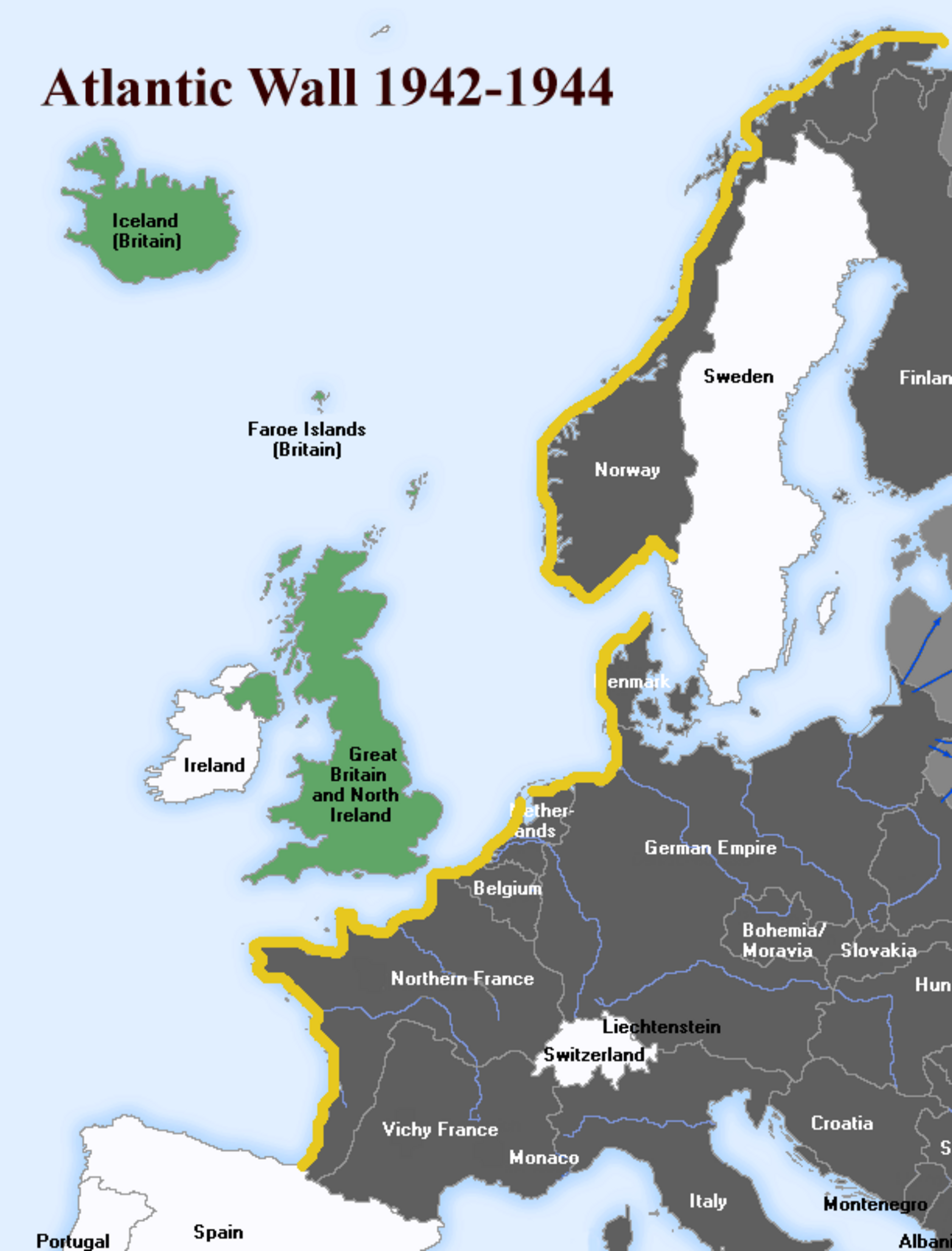
Eisenhower made the decision. The invasion would go ahead on 6 June 1944. A major storm, it later emerged, battered the Normandy coast from 19 to 22 June. Had the operation been postponed, it would have been impossible on the later date. Across the Channel, German meteorologists, with less access to Atlantic weather data, predicted two weeks of storms. Field Marshal Erwin Rommel, the German commander responsible for the Atlantic Wall defences, had left for Germany to give his wife a birthday gift and to petition Hitler for more tank divisions. Several other senior commanders were away at war games in Rennes.
Just after midnight on 6 June, the first Allied soldiers of D-Day were already in the air. BBC war correspondent Robert Barr had watched them prepare: 'Their faces were darkened with cocoa; sheathed knives were strapped to their ankles; tommy guns strapped to their waists; bandoliers and hand grenades, coils of rope, pick handles, spades, rubber dinghies hung around them.' Every man among them was going into combat for the first time.
The British operation came first, at 00:16, when gliders carrying soldiers of the Oxfordshire and Buckinghamshire Light Infantry landed beside the bridges over the Caen Canal and the River Orne. Both bridges were captured intact, with light casualties. They would later be renamed Pegasus Bridge and Horsa Bridge, and they remain among the most celebrated objectives of the entire war. Securing those crossings prevented German armour from sweeping around the eastern flank of the landing beaches.
Read full transcript (14 more paragraphs)
Elsewhere on the eastern flank, the British 6th Airborne Division had a harder night. Pathfinders blown off course set up navigation beacons too far east, and many paratroopers landed miles from their targets. A force tasked with destroying the Merville gun battery, which threatened the men about to land on Sword Beach, arrived at the rendezvous with only 160 of its 600 men. Lieutenant Colonel Terence Otway decided to attack regardless. His force disabled the guns with plastic explosives, suffering 75 casualties in the process, and discovered that the battery held smaller guns than intelligence had warned. The deadline of 06:00 was met.
On the western flank, the American airborne divisions dropped over the Cotentin Peninsula to secure causeways behind Utah Beach. Thick cloud broke their formations, and many paratroopers landed miles from their intended zones, some drowning in fields the Germans had deliberately flooded. Of the 101st Airborne's men, only about 2,500 of the roughly 6,000 dropped were under divisional control after twenty-four hours. The 82nd Airborne fared similarly. But the very chaos of the dispersal confused the German response and prevented a coordinated counter-attack during the critical first hours. The crossroads at Sainte-Mère-Église, the first town liberated in the invasion, was captured by the 82nd Airborne before dawn.
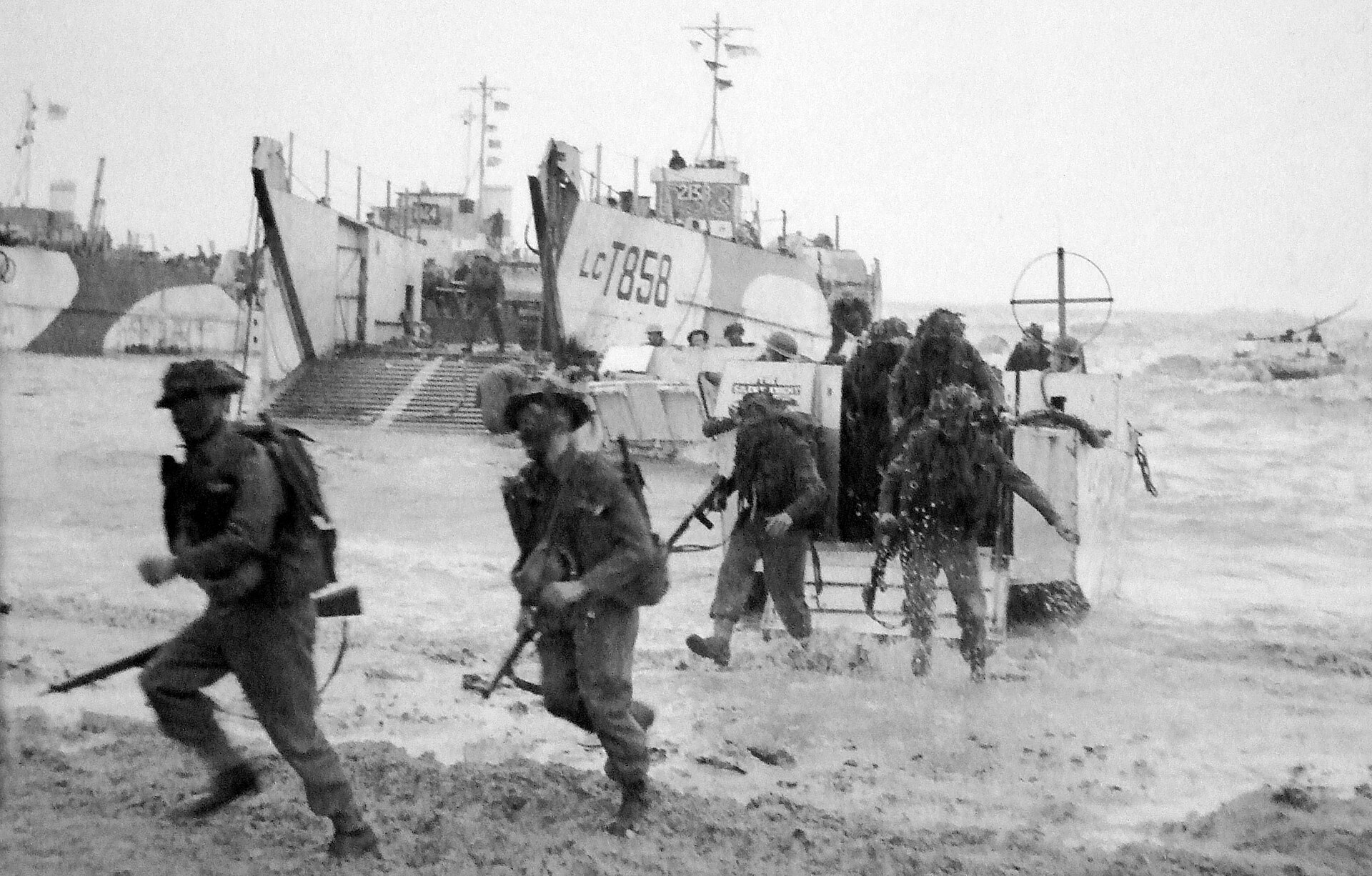
At 06:30 on the morning of 6 June, the first landing craft grounded on the beaches of Normandy. The eighty-kilometre stretch of coast had been divided into five sectors. From west to east: Utah, Omaha, Gold, Juno, and Sword. Each had its own defenders, its own obstacles, its own particular shape of difficulty. At Utah, strong currents pushed the landing craft south of their intended zone, which turned out to be fortunate: the defences there were lighter, and a single senior officer, Brigadier General Theodore Roosevelt Jr., the first general ashore, made the decision on the spot to redirect all subsequent landings to the new position. The 4th Infantry Division landed 21,000 troops at Utah at a cost of fewer than 200 casualties.
Omaha was a different world entirely. The beach was dominated by high bluffs, and the German division holding it was stronger than Allied intelligence had anticipated. Most of the amphibious tanks meant to give the infantry covering fire sank in the rough seas before reaching shore, 27 of 32 going down with the loss of 33 crew. Bombers tasked with destroying the beach defences had delayed their drops for fear of hitting the landing craft, and the obstacles remained intact. Men waded through chest-deep water under fire, crossed a beach covered with mines and barbed wire, and tried to find cover at the base of the cliffs. By late morning, barely 600 men had reached the high ground. Casualties at Omaha reached around 2,000.
What saved Omaha was a combination of individual courage and naval firepower. Destroyers came in dangerously close to shore to fire directly at the German positions above the beach. Small groups of soldiers, without orders from above, began cutting their own paths through the wire and up the gullies. By noon, as German ammunition began to run low, the Americans were clearing lanes through the beach obstacles and pushing up the bluffs. The D-Day objectives for Omaha would not be fully achieved until 9 June, three days late.
At Gold Beach, the British landed at 07:25, an hour later than the Americans because of tidal differences. The specialised armoured vehicles designed for the Normandy campaign, known informally as Hobart's Funnies, performed well here: a tank firing a large demolition charge finally silenced a German strongpoint at Le Hamel that had resisted everything else until 16:00. Three of the four guns at the Longues-sur-Mer battery had already been knocked out by naval gunfire before the troops arrived. Company Sergeant Major Stanley Hollis attacked two German pillboxes at the Mont Fleury high point and received the only Victoria Cross awarded on D-Day. Allied casualties at Gold were around a thousand.
The Canadians at Juno Beach faced choppy seas that delayed the landing and meant many men arrived ahead of their supporting armour. The German strongpoints at the beach towns had to be taken in house-to-house fighting. By nightfall, the Canadians had pushed between six and ten kilometres inland, and the Juno and Gold beachheads had been linked into a continuous front nineteen kilometres wide and ten kilometres deep. Casualties at Juno were 961 men.
At Sword Beach, the easternmost of the five, 21 of 25 amphibious tanks made it ashore successfully, giving the infantry better cover than at Omaha. Brigadier Simon Fraser, the 15th Lord Lovat, came ashore in the second wave with his commandos, piped onto the beach by his personal piper, Private Bill Millin. French commandos under Commander Philippe Kieffer, the first French soldiers to reach Normandy, cleared the fortified casino at Riva Bella. But the day's most dangerous moment came at 16:00, when a German armoured division mounted a counter-attack between Sword and Juno and nearly reached the Channel before being stopped by British infantry and recalled to deal with fighting further inland. Sword casualties reached around a thousand.
By the end of 6 June 1944, the Allies held beachheads at all five landing sites. The cost was enormous. Allied casualties on D-Day totalled at least 10,000, with 4,414 confirmed dead. German casualties are estimated between 4,000 and 9,000. French civilian casualties on D-Day and the following day reached roughly 3,000. None of the original objectives for the first day had been fully achieved: Carentan, Saint-Lô, and Bayeux remained in German hands. Caen, meant to fall on D-Day, would not be captured until 21 July. The five beachheads were not linked into a continuous front until 12 June.
And yet the landing had succeeded. Hitler's declared aim of throwing the Allies back into the sea was never achieved, not on 6 June and not at any point thereafter. The deception plan had worked: German commanders, still expecting a second, larger landing at Calais, held back their reserves. The Luftwaffe, outgunned over Normandy by more than ten to one, could not interfere with the fleet or the beaches. The French Resistance had severed the rail network. The Atlantic Wall, which Rommel himself reported was only eighteen per cent complete in some areas, had been breached at five points in a single morning.
German forces retreated east across the Seine on 30 August 1944, marking the end of Operation Overlord. By then, nearly 875,000 Allied soldiers had come ashore through the beaches and harbours of Normandy. The campaign that began in the grey water off Utah and Omaha and Gold and Juno and Sword eventually carried those soldiers, and the armies that followed them, all the way to Berlin.
At Omaha Beach today, parts of the artificial Mulberry harbour built after the landings are still visible in the water. A few of the original beach obstacles remain. The terrain at Pointe du Hoc, where two hundred Rangers scaled thirty-metre cliffs under fire to destroy guns that had already been moved, is still cratered from the bombardment of 1944, the concrete bunkers largely intact. The Normandy American Cemetery at Colleville-sur-Mer holds the graves of nearly ten thousand soldiers.
The scale of what happened on 6 June 1944 can be held in the numbers, but numbers are not quite enough. Nearly 160,000 men crossed a stretch of open water in the dark, toward a coast fortified over years, against defenders who knew an invasion was coming and had prepared accordingly. They came in landing craft that grounded on sandbars, past obstacles designed to tear hulls apart, under fire from positions on high ground. Thousands of them did not come back. The ones who did kept walking, inland, east, until the war was over.
What D-Day settled, more than any single objective on its target list, was the question of whether western Europe would be liberated at all. The answer, given in blood on five Normandy beaches over the course of one day, was yes.
Image: Chief Photographer's Mate (CPHoM) Robert F. Sargent, Public domain · AI-narrated · Drawn from Wikipedia · CC BY-SA 4.0