

Transcript
The Han dynasty ended almost two thousand years ago. Yet today, the majority ethnic group of China still calls itself the Han people. The language they speak is the Han language. The characters they write are Han characters. No other dynasty in Chinese history left its name so completely embedded in the identity of a civilisation. That is the paradox at the heart of this story: an empire that collapsed in civil war and usurpation, that was interrupted by a usurper, that saw its emperors reduced to puppets, still gave its name to a people who would endure for millennia.
To understand how that happened, we need to go back to 206 BC, when China's first imperial experiment had just destroyed itself. The Qin dynasty had unified the Warring States by brutal conquest in 221 BC, but its first emperor, Qin Shi Huang, died and left behind a regime too rigid to bend. Within four years of his death, rebellion had shattered the empire into fragments. Out of that chaos, two men competed for mastery of China: Xiang Yu, the charismatic warlord of Chu, and Liu Bang, a man of far humbler origins who had been given a small fief called Hanzhong, named after the Han River in what is now southwest Shaanxi.
Xiang Yu was the better general. Liu Bang was the better politician. At the Battle of Gaixia in 202 BC, fought in what is now Anhui province, Liu Bang's forces finally cornered and destroyed his rival. Xiang Yu died that day, and Liu Bang stood alone as master of China. His followers urged him to take the imperial title. He accepted. He is known to history as Emperor Gaozu, the founding emperor of the Han dynasty. He chose Chang'an, near modern Xi'an, as his capital, and the dynasty took its name from his original fief of Hanzhong. The Chinese character for Han also carried an older meaning: the Milky Way, the river of heaven.
Gaozu's first problem was not the Xiongnu to the north or the fractured south. It was his own commanders. To reward the men who had won him the empire, he had granted several of them kingdoms, making them semi-autonomous rulers over large chunks of territory. Almost immediately, their loyalty began to fray. By 196 BC, Gaozu had manoeuvred to replace every non-family king with a member of the Liu clan, with one exception. The loyalty of outsiders, he had concluded, was simply not reliable enough.
But even Liu family kings proved difficult to control. The kingdoms of the eastern two-thirds of the empire retained their own administrations, their own revenues, and their own ambitions. The tension between the centralising imperial court and the semi-autonomous kingdoms would simmer for decades, finally boiling over in 154 BC with the Rebellion of the Seven States. Seven kings rose simultaneously against the throne. The court crushed them, and in the aftermath, in 145 BC, enacted a series of reforms that stripped the kingdoms of real power. Kings could no longer appoint their own senior officials. That duty passed to the imperial court. Kings became nominal heads of their fiefs, collecting a slice of tax revenue as personal income. The kingdoms never disappeared entirely, but they never again threatened the dynasty's core.
To the north, a far more dangerous problem had been building since before Gaozu's reign. The Xiongnu, a nomadic confederation of the eastern Eurasian steppe, had been unified and expanded by their leader Modu Chanyu into a power that controlled Manchuria, Mongolia, and the Tarim Basin. When Gaozu attempted to stop Han-manufactured iron weapons from reaching Xiongnu hands through a trade embargo, the Xiongnu responded by invading what is now Shanxi. In 200 BC, they defeated Han forces at Baideng. It was a humiliation. The resulting heqin agreement of 198 BC nominally treated the two rulers as equals, bound by a royal marriage alliance, but in practice the Han paid tribute in silk, food, and wine to keep the Xiongnu from raiding. The steppe confederation had beaten the empire on the battlefield and extracted payment from it.
This arrangement persisted uneasily through the reigns of Gaozu's successors. Emperor Wen and Emperor Jing managed to stabilise the empire and reduce its debts, but the Xiongnu continued to raid across the Great Wall regardless of the tribute payments. The heqin policy was humiliating, and everyone at court knew it. The question was whether the empire had the resources and the will to do something about it.
The answer came with Emperor Wu, who came to the throne in 141 BC and would reign for fifty-four years. Wu is the towering figure of the Han dynasty, the ruler under whom the empire reached its greatest extent and defined its cultural character. In 135 BC, a court conference voted to retain the heqin agreement. Wu accepted the majority view. The following year, a new conference proposed something bolder: a covert operation to assassinate the Xiongnu leader at a place called Mayi. The plan failed in 133 BC. What followed was not retreat. It was war.
Emperor Wu launched a series of massive military campaigns into Xiongnu territory that continued for decades. The culmination came in 119 BC at the Battle of Mobei. Two Han commanders, Huo Qubing and Wei Qing, drove the Xiongnu court north of the Gobi Desert. Han forces reached as far as Lake Baikal. It was one of the most decisive military victories in the dynasty's history. The Xiongnu were not destroyed, but they were broken as a strategic threat. Their grip on the Hexi Corridor, the narrow land bridge connecting China proper to Central Asia, was severed. In 121 BC, Han forces had already expelled the Xiongnu from the territory stretching from the Hexi Corridor to the desert basin of Lop Nur. The court established four new frontier commanderies there, including Dunhuang, to consolidate control.
Read full transcript (28 more paragraphs)
Wu did not stop at the northern steppe. He sent his armies south and east as well. In 111 BC, a naval campaign conquered Nanyue, adding what are now Guangdong, Guangxi, and northern Vietnam to the Han realm. In 109 BC, the Dian Kingdom in modern Yunnan was absorbed. A year later, in 108 BC, Han forces conquered Gojoseon on the Korean Peninsula and established new commanderies there. The empire had grown in almost every direction within a single reign.
These conquests were expensive. To pay for them, Wu nationalised major industries. In 117 BC, he took control of the salt and iron industries, creating government monopolies administered largely by former merchants who knew the trade. The liquor industry was nationalised in 98 BC, though that monopoly lasted only until 81 BC. Coinage became a central government monopoly in 113 BC, and the wuzhu coin introduced by Wu in 119 BC became China's standard currency, remaining so until the Tang dynasty, more than seven centuries later.
Before Wu's military campaigns had even finished, his diplomat Zhang Qian had already opened something equally consequential. Between 139 and 125 BC, Zhang Qian travelled west on diplomatic missions, making contact with the kingdoms of Fergana, Sogdiana, and Bactria, and gathering intelligence on the Parthian Empire and the Indus River valley. He was looking for allies against the Xiongnu. He found something larger: a network of trade routes that connected China to the known world. These connections became the Silk Road. Chinese silk travelled west; Roman glassware travelled east. The Han were no longer a regional power contained within China's historical heartland. They were a node in a global trading network.
The Tarim Basin, the chain of oasis city-states that controlled the central routes of the Silk Road, was contested between Han and Xiongnu forces from around 115 BC until around 60 BC. The Han eventually won. In 60 BC, the court established the Protectorate of the Western Regions to administer the area's defence and foreign affairs. The Silk Road was now under Han protection, and the tribute and trade that flowed through it enriched the empire while extending its cultural reach.
Emperor Wu also made a decision that shaped China's intellectual life for two thousand years. In 136 BC, he abolished all academic chairs not concerned with the Five Classics of Confucian learning. In 124 BC, he established the Imperial University, where candidates for government office received a Confucian education. The philosophical synthesis that justified this was created by a scholar named Dong Zhongshu, who wove together Confucian ethics of ritual and filial piety with yin-yang cosmology, arguing that the imperial system reflected the natural order of the universe itself. Han Confucianism was not quite what Confucius had taught: it was something new, designed to serve an empire. But it worked. The Imperial University eventually grew to a student body of over thirty thousand by the second century AD.
The Han dynasty was not only a military and philosophical achievement. It was a period of remarkable practical ingenuity. The standard papermaking process was invented by a court official named Cai Lun in 105 AD, transforming how knowledge could be stored and spread. The Han produced the world's first seismometer, designed by the court astronomer Zhang Heng, a device using an inverted pendulum to detect the direction of distant earthquakes by dropping a metal ball from one of eight dragon mouths into a toad's mouth below. On one recorded occasion, the device indicated an earthquake in a distant commandery before any messenger had arrived with the news. Officials at court were forced to admit it worked.
Zhang Heng also built a mechanically rotating armillary sphere, a three-dimensional model of celestial movements, powered by a water clock and gears. Han mathematicians made the world's first recorded use of negative numbers, in a text called where positive numbers were represented by red counting rods and negative numbers by black. Han farmers used a three-legged iron seed drill invented by the second century BC, planting in rows rather than scattering seed by hand. Han ships were the first in the world steered by a rudder at the stern, enabling deep-sea navigation. These were not isolated curiosities; they were the products of a society that had built administrative structures capable of directing and recording organised knowledge.
The administrative machinery of the Han state was itself a formidable invention. The empire was divided into commanderies and counties, each with its own hierarchy of officials. A county magistrate registered the population for taxation, mobilised men for annual labour duties, maintained schools, and supervised public works. Above him, administrators of commanderies handled defence, lawsuits, and recommendations for office. The whole system was staffed by scholar-officials selected partly through a Confucian education, creating a meritocratic bureaucracy that would outlast the dynasty itself and become the template for every subsequent Chinese imperial government.
Even the most durable institutions carry within them the seeds of their own disruption. By the last decades of the Western Han, real power had begun to drift away from the emperors. A succession of short-lived or weak rulers left the court increasingly dominated by the families of their empresses and empress dowagers. One woman in particular, Wang Zhengjun, held influence at court across three consecutive reigns as empress, then empress dowager, then grand empress dowager. During that long tenure, a succession of her male relatives held the title of regent. After the death of Emperor Ai in 1 BC, her nephew Wang Mang was appointed regent as Marshall of State.
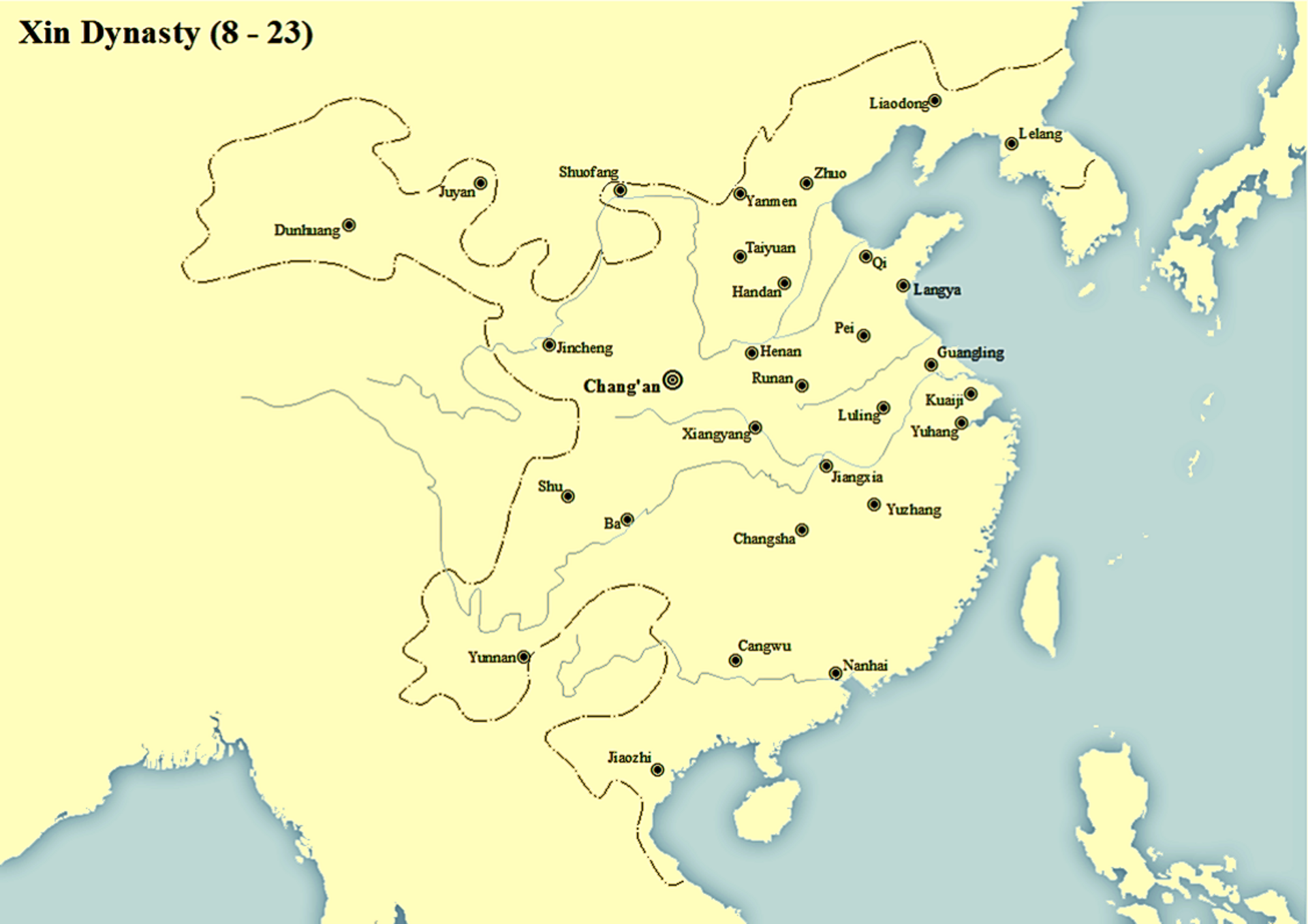
Wang Mang was careful, patient, and ambitious. When the child emperor Ping died in 6 AD, a new infant heir was selected and Wang Mang was appointed acting emperor. He promised to relinquish power when the child came of age. He did not. On the tenth of January in 9 AD, Wang Mang declared that the divine Mandate of Heaven had transferred from the Han to a new dynasty: his own, which he called the Xin dynasty. The Han dynasty, for the moment, was over.
Wang Mang attempted genuine reform. He outlawed slavery, tried to redistribute land equally between households, and introduced new currencies. None of it worked. The currency changes debased coinage and triggered inflation. The land reforms provoked the opposition of powerful landowners. And then nature intervened with a catastrophe no policy could contain. The Yellow River, its bed raised by centuries of silt accumulation, burst through its flood control works. Around 3 AD and again around 11 AD, massive floods displaced thousands of peasant farmers across the northern plains. Many of them joined roving rebel bands to survive. The largest of these groups called themselves the Red Eyebrows. Wang Mang's armies could not suppress them.
The end came violently. An insurgent mob forced their way into the Weiyang Palace and killed Wang Mang. A descendant of the old Han line attempted to restore the dynasty and occupied Chang'an, but was overwhelmed by the Red Eyebrow rebels, who deposed and assassinated him. Out of this chaos, a man emerged who would actually succeed. Liu Xiu, a distant cousin of the old imperial line, had distinguished himself in battle at Kunyang in 23 AD. In 25 AD, his followers urged him to take the imperial title. He accepted, and is known to history as Emperor Guangwu. He made Luoyang his capital. The Han dynasty had been restored.
Emperor Guangwu spent the next decade and more consolidating his restoration. By 27 AD, his officers had forced the Red Eyebrows to surrender and executed their leaders. From 26 until 36 AD, he fought a series of campaigns against regional warlords who had claimed imperial titles of their own during the chaos. When the last of them was defeated, China was reunified under the Han. The capital's move from Chang'an westward to Luoyang marked the division historians draw between the Western Han and the Eastern Han, though the dynasty's ruling family, its Confucian ideology, and its administrative structures remained continuous.
The Eastern Han quickly reasserted its reach. The Trưng Sisters of Vietnam led a rebellion against Han authority in 40 AD. A Han general crushed it in a campaign lasting from 42 to 43 AD. The Xiongnu, who had grown fractious during the Wang Mang interregnum, eventually split into two rival confederations: a southern branch that submitted to Han as a tributary vassal in 50 AD, and a northern branch that remained hostile. Han forces fought the northern Xiongnu for decades across the steppe and the Tarim Basin, finally achieving a decisive victory at the Battle of Ikh Bayan in 89 AD, after which the northern Xiongnu fled into the Altai Mountains and eventually into the Ili River valley. The nomadic Xianbei then occupied the vacated steppe.
In Central Asia, a Han commander named Ban Chao extended the empire's reach deep into the oasis states of the Tarim Basin. He even attempted to open direct contact with Rome, sending an emissary named Gan Ying westward in 97 AD. The mission did not reach Rome, but the gesture reflected the Han court's awareness of a world extending far beyond China's borders. In 166 AD, a group of travellers claiming to represent the Roman emperor Marcus Aurelius reached the Han court, though they were likely merchants rather than an official embassy.
The reign of Emperor Zhang, who ruled from 75 to 88 AD, came to be regarded by later Eastern Han scholars as the high point of the restored dynasty. What followed was a long, slow deterioration. The mechanism of decline was not military defeat from outside but institutional rot from within. The emperors of the later Eastern Han were often children when they came to the throne, meaning real power was exercised by regents: typically the empress dowager and her male relatives. When an emperor came of age and tried to reclaim authority, he often turned to palace eunuchs, the only men he could trust who owed him everything and had no powerful clan behind them.
In 92 AD, Emperor He used a eunuch ally to place his predecessor's powerful clan under house arrest and strip them of power. This set the pattern for the following century: empresses' clans and eunuch factions in perpetual, violent competition for control of the court. Each cycle of the struggle left the imperial institution weaker and the dynasty's credibility more damaged. Emperor Huan, who reigned from 146 to 168 AD, hosted thousands of concubines in his palace while auctioning off top government offices, even as the empire faced economic crisis. Students from the Imperial University organised widespread protests against the eunuchs at his court. The eunuchs had protesters imprisoned on charges of treason. A court official eventually secured their release, but the emperor permanently barred them from office. This episode marked the beginning of what became known as the Partisan Prohibitions, a systematic exclusion of the educated gentry class from government.
After Huan's death in 168 AD, two senior officials attempted a coup against the dominant eunuch faction. The plot was uncovered. The eunuchs arrested the empress dowager. One of the coup's leaders was confronted by troops at the palace gate, his own retainers gradually deserting him. He was forced to commit suicide. The eunuchs tightened their grip. Under Emperor Ling, who reigned from 168 to 189 AD, the Partisan Prohibitions were renewed and expanded. Affairs of state were largely entrusted to two senior eunuchs while the emperor spent his time in private amusements. The gentry class, barred from office, increasingly concluded that cultivating private moral relationships mattered more than serving a government this corrupt.
The breaking point came in 184 AD, not in the palace but across eight provinces simultaneously. Two Taoist religious societies, the Yellow Turbans led by a faith healer named Zhang Jue, and the Five Pecks of Rice movement led by Zhang Lu, launched coordinated rebellions. The Yellow Turbans were crushed within a year by Han forces. But the damage was permanent. To fight the rebellions, the court had authorised generals across the empire to raise their own militias. When the fighting ended, many of those generals simply kept their armies. The court had traded its military monopoly for survival, and the price was control of the empire.
Emperor Ling died in 189 AD. What followed was rapid and brutal. The general-in-chief He Jin plotted with the warlord Yuan Shao to use several generals' armies to pressure the empress dowager into ordering the execution of the eunuchs. The empress hesitated, then consented. The eunuchs found out. They assassinated He Jin on the twenty-second of September 189. Yuan Shao immediately stormed the palace. Within days, approximately two thousand eunuchs had been killed. The eunuch faction that had dominated the court for a century was gone. But the dynasty went with it.
A general named Dong Zhuo found the young emperor and his younger brother wandering in the countryside after the palace massacre, and escorted them back to the capital. He then used his army to take control of Luoyang, demoting the young emperor and installing the brother, Liu Xie, as Emperor Xian. Yuan Shao organised a coalition of former officials and officers against Dong Zhuo. Dong responded by burning Luoyang to the ground and forcibly relocating the court to Chang'an in May 191 AD. He was assassinated the following year by his own adopted son in a conspiracy, but the damage was done. The empire had fractured into competing warlord territories, each with its own army and its own ambitions.
Emperor Xian spent the next two and a half decades as a puppet. He fled the ruins of Chang'an in 195 AD, making his way to the devastated Luoyang. A warlord named Cao Cao, then governor of a province in what is now western Shandong and eastern Henan, persuaded the emperor to move the imperial capital to Xuchang in 196 AD, where Cao could manage him directly. Yuan Shao challenged Cao Cao for control of the emperor. Cao defeated him decisively at the Battle of Guandu in 200 AD. Yuan Shao's sons quarrelled over the inheritance and were picked off one by one. By 207 AD, Cao Cao was the dominant power in northern China.
His attempt to extend that dominance southward failed at the naval Battle of Red Cliffs in 208 AD. Cao Cao's fleet was destroyed by the combined forces of two southern warlords, Sun Quan and Liu Bei. China settled into three spheres of influence: Cao Cao in the north, Sun Quan in the south, Liu Bei in the west. The Han emperor remained, technically, on the throne. But he ruled nothing. Cao Cao died in March 220 AD. By December, his son Cao Pi had Emperor Xian formally relinquish the throne. The Han dynasty was over.
Cao Pi declared himself the first emperor of the new state of Wei. The act was framed as a voluntary abdication, the Mandate of Heaven peacefully transferred. Liu Bei refused to accept it, declaring himself the legitimate continuation of the Han line in the west. Sun Quan eventually proclaimed his own dynasty in the south. The age of the Three Kingdoms had begun, a period of division and war that would last until 280 AD. The Han dynasty, in its two periods of Western and Eastern continuity, had lasted more than four centuries.
The first nationwide census in Chinese history, taken in 2 AD, registered a population of nearly fifty-eight million people across more than twelve million households. The Han had governed all of them through a bureaucratic system staffed by Confucian-educated officials, selected by examination and recommendation, administered through a hierarchy of provinces, commanderies, and counties. That system did not die with the dynasty. It became the template for every subsequent Chinese imperial government, refined and extended for two thousand years.
The coinage Wu had minted in 119 BC remained China's standard until the Tang dynasty. The papermaking process invented under the Eastern Han spread eventually to the Islamic world and then to Europe, transforming how human knowledge was recorded and transmitted across civilisations. The seismometer, the armillary sphere, the rudder-steered ship, the seed drill, the waterwheel powering iron bellows: these were not curiosities but working technologies embedded in the economy and administration of a continent-spanning state.
The Confucian synthesis that Emperor Wu had institutionalised in 136 BC shaped Chinese political philosophy, family structure, and social hierarchy for longer than the Roman Empire lasted. The historians Sima Tan and his son Sima Qian, writing in Wu's reign, created the which established the standard model for official history writing in China. Every dynasty that followed would write its own history in the form the Han had invented.
What endures most completely is the name itself. The Han dynasty's defining act was not a single battle or a single emperor's decision. It was the slow accumulation of institutions, technologies, philosophies, and identities that fused a diverse, fractured civilisation into something coherent enough to call itself by one name. When the dynasty finally fell and the Three Kingdoms tore China apart, the people who lived through it did not stop being Han. The empire had ended. The people had not. That is why, two thousand years later, the majority of the world's most populous nation still carries the dynasty's name as their own.
Image: Gary Lee Todd, Ph.D., CC0 · AI-narrated · Drawn from Wikipedia · CC BY-SA 4.0