

Photo: unknown, Republic of the Congo (Léopoldville) government · Commons · Public domain · Cropped & Resized
Transcript
Somewhere in the depths of the Congo Basin, a harpoon carved from bone was dropped into the river roughly ninety thousand years ago. It was found again in 1988, near Katanda in the east of the country, barbed and precise, designed to bring up giant catfish from the current. That single object tells you something essential about this place: human beings have been mastering this river, and living and dying by it, for longer than almost anywhere else on earth.
The Congo River is the second longest in Africa and the deepest in the world. It drains a basin roughly the size of Western Europe, threading through equatorial forest so dense that entire civilisations grew up inside it without the outside world knowing they existed. The river is not a backdrop to this country's story. It is the story's spine.
The first Bantu-speaking peoples reached Central Africa during the first millennium before the common era, spreading southward and accelerating their expansion through pastoralism and iron-working. Metal tools transformed agriculture. Older foraging communities, including the African pygmies, were gradually displaced. By around the seventh century, three distinct centres of political organisation had formed inside the modern territory: one near Pool Malebo in the west, one around Lake Mai-Ndombe, and a third further south around the Upemba Depression.
By the thirteenth century, the western Congo Basin contained several federations of states. The most powerful was rooted in the east of this western zone, a grouping sometimes called the Seven Kingdoms, which likely included Nsundi, Mbata, and Mpangu among others. South of them lay Mpemba, stretching from what is now Angola to the Congo River itself. These were not primitive chiefdoms: they were structured polities with courts, trade networks, and recognised hierarchies of authority.
The Kingdom of Kongo emerged as the dominant power from the fourteenth century onward, controlling much of western and central Africa. At its height it held perhaps half a million people, with its capital at M'banza-Kongo. Alongside it stood the Kingdom of Luba, the Kingdom of Lunda, and the Mongo people, each commanding territory across the vast interior. These were the civilisations that Portuguese sailors encountered when their ships rounded the west African coast in the late fifteenth century.
The Portuguese arrival changed everything. Trade brought prosperity and consolidation, and the Kongolese king's power grew on the back of that commerce. But the same trade carried a catastrophe. King Afonso the First, who ruled from 1506 to 1543, carried out raids on neighbouring districts in direct response to Portuguese demands for enslaved people. He was compliant, and the kingdom prospered, and the coast began to bleed.
The Atlantic slave trade ran from roughly 1500 to 1850, and the region around the mouth of the Congo River suffered its most intensive violence. Along a strip of coast about four hundred kilometres long, around four million people were enslaved and shipped across the Atlantic to sugar plantations in Brazil, the Caribbean, and what would become the United States. From 1780, American demand surged. By that year, more than fifteen thousand people were being shipped annually from the Loango Coast alone. The Kingdom of Kongo never recovered. After Afonso died, it entered a crisis from which it would not emerge before European colonisers arrived to finish what the trade had started.
In 1870, a journalist and explorer named Henry Morton Stanley pushed into the Congo interior. Nine years later, King Leopold the Second of Belgium hired him. Leopold's goal was not Belgium's enrichment in any national sense: he wanted a personal empire. He worked through a front organisation of which he was sole shareholder, publicly presenting his ambitions as humanitarian while playing European powers against one another. At the Berlin Conference of 1885, he was formally awarded sovereign rights over the Congo territory. He named it the Congo Free State. It was not a colony of Belgium. It was his private possession.
Colonisation began immediately. The first priority was infrastructure: a railway connecting the navigable upper Congo River to the coast at Matadi, built through brutal terrain at the cost of many lives. Once goods could move, the extraction began in earnest. The resource Leopold wanted most was rubber, driven by the global boom in bicycle and automobile tyres. Congolese villages were tied to strict quota systems. The Force Publique, Leopold's private army of white officers and African soldiers, enforced those quotas with systematic terror.
The methods were specific and deliberate. Villages that failed to meet rubber quotas faced armed reprisals. Family members were taken hostage until quotas were met. The Force Publique tortured, flogged, and killed. Most notoriously, soldiers were required to produce severed hands as proof that their bullets had not been wasted, a practice that extended to the hands of children. Sentries reportedly killed and ate workers who underperformed. The scale of what happened between 1885 and 1908 is still debated, but estimates range from one point two million to thirteen million Congolese dead, from violence, starvation, and disease. In some areas, sleeping sickness and smallpox alone killed nearly half the population.
In 1904, the British consul at Boma, Roger Casement, was instructed to investigate. His report confirmed everything. It led to the arrest of Belgian nationals responsible for cold-blooded killings during rubber expeditions. An independent commission of inquiry, forced on Leopold by the Belgian Parliament that same year, concluded that the population of the Congo had been reduced by half during his rule. By 1908, even European powers engaged in their own violent colonial projects regarded Leopold's regime as beyond the pale. On the eighteenth of October 1908, the Belgian Parliament voted to annex the Congo, stripping Leopold of his possession. On the fifteenth of November, he formally relinquished control. The Congo Free State became the Belgian Congo.
Read full transcript (25 more paragraphs)
The transition from Leopold's personal rule to Belgian state administration was a break, but it was also, in important ways, a continuity. The last governor-general of the Congo Free State stayed in his post. The most extreme physical violence diminished, but forced labour, institutionalised racial discrimination, and the extraction of natural wealth continued. All major decisions affecting the Congo were taken in Brussels, by white officials, without any African involvement whatsoever.
Belgian rule rested on what administrators called the colonial trinity: state authority, missionary activity, and private commercial interest. Large companies received concessions and broke strikes with state assistance. A dual legal system operated: European courts for white settlers, indigenous tribunals with sharply limited authority for Congolese. Capital punishment applied only to Black Congolese. Access to higher education was largely denied to them. Residential areas and social facilities were segregated. The system was, in practice, a form of apartheid.
The Belgian Congo was drawn into both world wars. During the First World War, the Force Publique fought alongside British and Portuguese forces against German colonial forces in East Africa, marching into Tabora in September 1916 after heavy fighting. In the Second World War, the colony provided crucial income for the Belgian government in exile in London, and Congolese forces under Belgian command fought the Italian colonial army in Ethiopia. The Congo's mineral wealth proved decisive in a more chilling way: much of the uranium used in the American nuclear programme during the Second World War came from Congolese mines.
Through the 1940s and into the 1950s, the colonial administration began development programmes intended to make the territory a model colony. Urbanisation accelerated. A Congolese wage labour force emerged that was twice the size of that in any other African colony. A new educated middle class, the évolués, took up skilled positions as clerks, nurses, and administrators. But the ceiling above them was rigid. The first Congolese citizen graduated from university only in 1956. Political activity was forbidden. And as the Cold War deepened, both the Soviet Union and the United States began to take a very close interest in who would control the Congo when Belgian rule ended.
By the late 1950s, the question was no longer whether the Congo would become independent but how fast. Riots in Léopoldville in January 1959, sparked when a political rally was cancelled and crowds turned on European property, shocked Belgium. Three days of violence followed. The colonial army suppressed the uprising with considerable brutality. An investigative commission found the riots to be the culmination of racial discrimination, unemployment, overcrowding, and the desire for self-determination. King Baudouin announced that independence would come.
At a Round Table Conference in Brussels beginning in January 1960, Belgian and Congolese leaders negotiated the terms. On the twenty-seventh of January, elections were announced for May, and full independence was set for the thirtieth of June 1960. The elections produced Patrice Lumumba, leader of the Mouvement National Congolais, as prime minister, and Joseph Kasa-Vubu as president. Lumumba was thirty-four years old. He had been arrested by the Belgians only months before. Now he would govern a country the size of Western Europe with almost no trained administrators, almost no experienced officers, and almost no time.
Independence arrived on the thirtieth of June 1960. Within days, the country was fracturing. On the fifth of July, Congolese soldiers mutinied against their European officers in the capital. On the eleventh of July, Katanga, the richest province, declared secession under Moïse Tshombe, backed by Belgian officers and mining interests. The United Nations sent peacekeepers to protect Europeans and attempt to restore order. Western mercenaries, hired by mining companies, poured in. On the eighth of August, the second-richest province, Kasai, also declared independence. The Republic of the Congo was less than two months old, and it was already being dismembered.
Lumumba turned to the United States for help. Washington refused. He turned to the United Nations. The UN forces were ordered not to intervene in internal political disputes. He turned to the Soviet Union. Nikita Khrushchev agreed, sending weapons and technical advisors. That decision sealed his fate. The United States, alarmed by Soviet presence in sub-Saharan Africa, began working to remove him. Lumumba was dismissed from office on the fifth of September 1960 by President Kasa-Vubu, who blamed him publicly for army massacres in South Kasai and for the Soviet entanglement. On the fourteenth of September, with CIA support, a colonel named Joseph Mobutu overthrew the government and had Lumumba arrested.
What happened next took place in stages, and each stage was worse than the last. On the seventeenth of January 1961, Mobutu sent Lumumba to Élisabethville, the capital of Katanga. In full view of the press, he was beaten and forced to eat copies of his own speeches. For three weeks, he was not seen or heard from. Then Katangan radio announced, implausibly, that he had escaped and been killed by villagers. A Belgian inquiry in 2001 established the truth: Lumumba had been shot by Katangan gendarmes in the presence of Belgian officers. He was beaten, executed by firing squad alongside two allies, buried, exhumed, and what remained was dissolved in acid. He was thirty-five years old.
The Congo Crisis ground on until 1965. Soviet and Cuban-backed rebels called the Simbas rose in the east in 1964, seizing significant territory and taking white hostages. Belgian and American forces pushed them out of Stanleyville in a hostage rescue operation in November 1964. Congolese government forces, aided by European mercenaries, crushed the last Simba resistance by November 1965. The Simbas had executed around twenty thousand Congolese and nearly four hundred Western hostages during the rebellion. Tens of thousands more died in the suppression.
With the crisis finally over, Mobutu moved. In November 1965, the general who had arrested Lumumba declared himself president for the next five years. He consolidated power swiftly, won a sham election in 1970, and in 1971 renamed the country the Republic of Zaire. The name came from Portuguese, adapted from the Kongo word for river. Leopoldville became Kinshasa. Katanga became Shaba. Mobutu himself changed his name to Mobutu Sese Seko and required all citizens to abandon their Western names for African ones. He called this Authenticity: a programme of cultural nationalism that served, above all, as a mechanism for absolute personal control.
Zaire became a one-party state, and Mobutu became its only permitted idea. He enriched himself on a colossal scale, embezzling state funds while the country's infrastructure decayed. In 1977 and 1978, rebel forces based in Angola launched two invasions into the Shaba region. French and Belgian paratroopers, along with Moroccan troops, drove them back. Throughout the 1980s, Mobutu successfully suppressed opposition, though parties like the Union pour la Démocratie et le Progrès Social remained active underground. International criticism mounted but produced no consequences.
As the Cold War ended, Mobutu's external protections collapsed. In late 1989 and into 1990, domestic protests multiplied, the economy deteriorated, and the full scale of his corruption became impossible to ignore. In April 1990, he announced a limited move toward multi-party politics. It changed almost nothing. In September 1991, unpaid soldiers began looting Kinshasa. Two thousand French and Belgian troops arrived to evacuate foreign nationals. In 1992, a national conference of over two thousand representatives elected Étienne Tshisekedi, leader of the main opposition party, as prime minister. Mobutu simply created a rival government. By 1994, the two had merged into a stalemate administration with Mobutu nominally in charge and elections promised but never held.
By 1996, the catastrophe unfolding in neighbouring Rwanda had crossed the border. Hutu militia forces who had fled Rwanda after the genocide had been using refugee camps in eastern Zaire as bases for incursions back into Rwanda. Rwandan forces struck the camps in October 1996, scattering refugees and driving west. Congolese Tutsis, already under attack from Hutu militias allied with Zaire's own army, formed militias of their own. Those militias joined a coalition led by a veteran opposition figure named Laurent-Désiré Kabila, and that coalition, backed by Rwanda and Uganda, began marching toward Kinshasa.
The advance was rapid. Peace talks between Mobutu and Kabila in May 1997 failed. On the sixteenth of May, Mobutu left the country. The coalition entered Kinshasa unopposed the following day. Kabila named himself president, marched into the capital on the twentieth of May, and restored the country's name: the Democratic Republic of the Congo. Mobutu died in exile in Morocco that September, the kleptocrat who had hollowed out a nation for three decades reduced at the end to a man without a country.
Kabila proved unable to manage what he had inherited. He had won power with Rwandan and Ugandan support, but he could not afford to be seen as their client. In August 1998, barely a year after taking power, he broke with both governments. They responded by backing a new rebel movement, the Movement for the Liberation of Congo, led by a warlord named Jean-Pierre Bemba, which attacked from the north and east. Angola, Namibia, and Zimbabwe intervened militarily on Kabila's side. Six African governments were now at war inside the Congo, and millions of civilians were caught between them.
A ceasefire was signed in Lusaka in July 1999 by the six governments. The Congolese rebel factions did not sign it, and it collapsed within months. The war continued. Reports documented systematic looting of the country's natural resources, including diamonds, copper, and coltan, by forces on every side. The conflict was, for many of its participants, as much an extraction operation as a military campaign. Three-quarters of the Congolese population would later report being affected by the violence, either directly or through its wider consequences.
Then, in January 2001, Laurent Kabila was shot dead by a bodyguard named Rashidi Kasereka, who was eighteen years old and was himself killed immediately afterwards. Laurent's son Joseph, who was twenty-nine, succeeded him. Joseph called for multilateral peace talks. He brokered a deal with Uganda and Rwanda that led to the apparent withdrawal of foreign troops. A transitional government was established in July 2003. By June of that year, all foreign armies except Rwanda's had pulled out. The Second Congo War, which had killed or displaced millions of people, was formally over. The reckoning for what had happened never fully arrived.
On the thirtieth of July 2006, the Congo held its first multi-party elections since independence. Joseph Kabila took forty-five per cent of the vote. A second round in October gave him seventy per cent. On the sixth of December 2006, he was sworn in as president. The country had a constitutional government for the first time in its modern history. It was a real achievement. It was also, as events would show, a fragile one.
In December 2011, Kabila was re-elected in a poll that international observers described as lacking credibility. Returns from nearly two thousand polling stations in areas of strong opposition support had disappeared from the official count. The opposition candidate, Étienne Tshisekedi, refused to accept the result and declared himself president in a parallel ceremony. In January 2015, students at the University of Kinshasa led protests against a proposed law that would have allowed Kabila to remain in power until a national census could be held. Police killed at least forty-two people in the clashes. In September 2016, further protests were suppressed with similar brutality. Kabila's mandate expired in December 2016. He made no plans for an election.
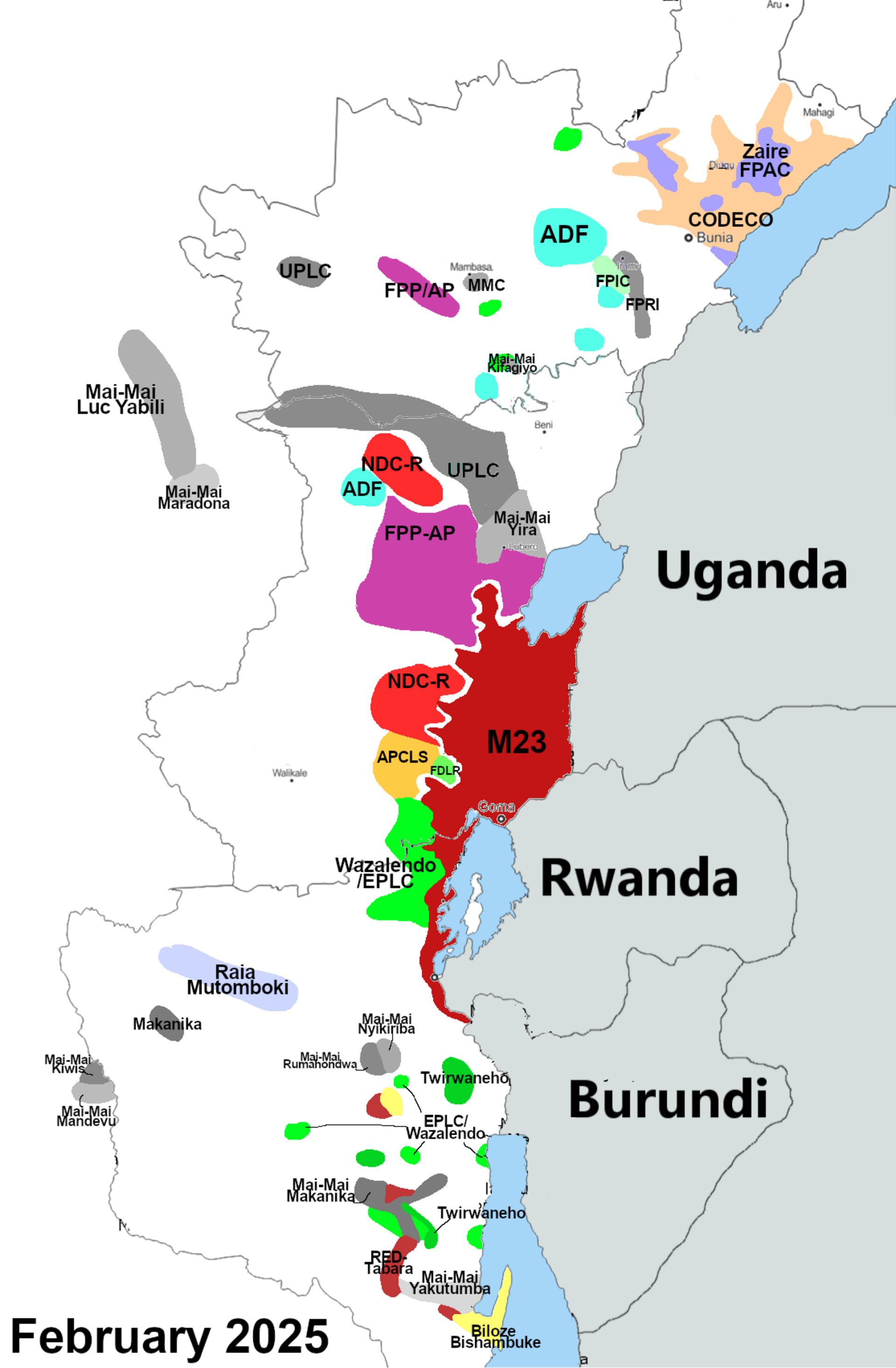
While the political crisis over Kabila's tenure played out in Kinshasa, the east of the country was being torn apart by dozens of armed groups. In 2012, a rebel movement called M23, believed to be backed by Rwanda, seized Goma, a provincial capital of one million people. A specially mandated United Nations intervention force defeated M23, but the underlying conditions that produced it, ethnic competition, foreign interference, and the vast mineral wealth of eastern Congo, remained entirely unchanged. By 2018, an estimated one hundred and twenty armed groups were operating across the country, possibly the largest concentration of active militias anywhere in the world.
The violence was not random. In Kivu, Congolese Tutsi communities called the Banyamulenge faced attacks from Hutu militias and other ethnic groups who regarded them as outsiders. In Katanga, the Pygmy Batwa people, long exploited by the Luba, rose up in militia violence that killed hundreds and displaced tens of thousands. In Kasai, a militia led by a traditional chief attacked state institutions from 2016; by June 2017, more than three thousand three hundred people had been killed and twenty villages completely destroyed. In Ituri, fighting between the Lendu and Hema peoples, rooted in colonial-era discrimination, had continued with only brief interruptions since the late 1990s. In every case, the Congolese state's inability to provide security created the space in which violence flourished.
On the thirtieth of December 2018, a presidential election was held. The electoral commission announced on the tenth of January 2019 that Félix Tshisekedi, the son of the opposition leader Étienne Tshisekedi who had died two years earlier, had won. On the twenty-fourth of January 2019, Tshisekedi was sworn in as president. It was the first peaceful transfer of power since independence in 1960. The significance of that fact is hard to overstate in a country where political transitions had, for six decades, meant coups, assassinations, and wars.
Tshisekedi moved to consolidate his position against the networks loyal to the outgoing Kabila, which controlled key ministries, the legislature, the judiciary, and the security services. By April 2021, he had won over enough legislators to form a government without Kabila's allies. He declared states of emergency in North Kivu and Ituri province to tackle the Allied Democratic Forces, an armed group blamed for massacres across the east and linked by the United States to the Islamic State. The emergencies gave the military control over civilian administration in those provinces, and the violence continued regardless. In December 2023, Tshisekedi was re-elected with seventy-three per cent of the vote; nine opposition candidates rejected the result and called for a rerun.
The Congo's story does not resolve into a clean ending, because it has not ended. The river that the Katanda harpoon was carved to fish ninety thousand years ago still runs through one of the most resource-rich and most devastated territories on the planet. The land beneath it holds cobalt, coltan, diamonds, copper, and uranium, minerals the modern world cannot function without, and that wealth has drawn outsiders to take and insiders to fight over for as long as anyone can remember. What the country has never been given is time: time free from extraction, from colonial administration, from Cold War manipulation, from regional proxy war, from the ambitions of its own rulers. What it has produced, despite all of that, is survival, and an identity forged not from peace but from endurance.
Image: unknown, Republic of the Congo (Léopoldville) government, Public domain · AI-narrated · Drawn from Wikipedia · CC BY-SA 4.0