
Transcript
Picture a priest standing at the edge of a swampy island in a highland lake sometime around 1325. He is not standing on promising ground. The water is shallow and brackish, the soil thin, the reeds thick with mosquitoes. But above him, perched on a prickly pear cactus growing from the rocks, an eagle tears at a snake. According to the belief of the Mexica people, this was the sign they had been waiting for. This was where they would build their city.
The people who would become the Aztecs had been wandering for generations. They called themselves the Mexica, and they traced their origins to a mythical northern homeland called Aztlan, a word meaning roughly 'place of herons' or 'place of whiteness'. Their tribal deity Huitzilopochtli, the god of the sun and of war, had commanded them to leave Aztlan and seek a new home. He had also commanded them to abandon the name Aztec and call themselves Mexica. So the word 'Aztec', which the world now uses for them, was never a name they gave themselves. It was the name they left behind.
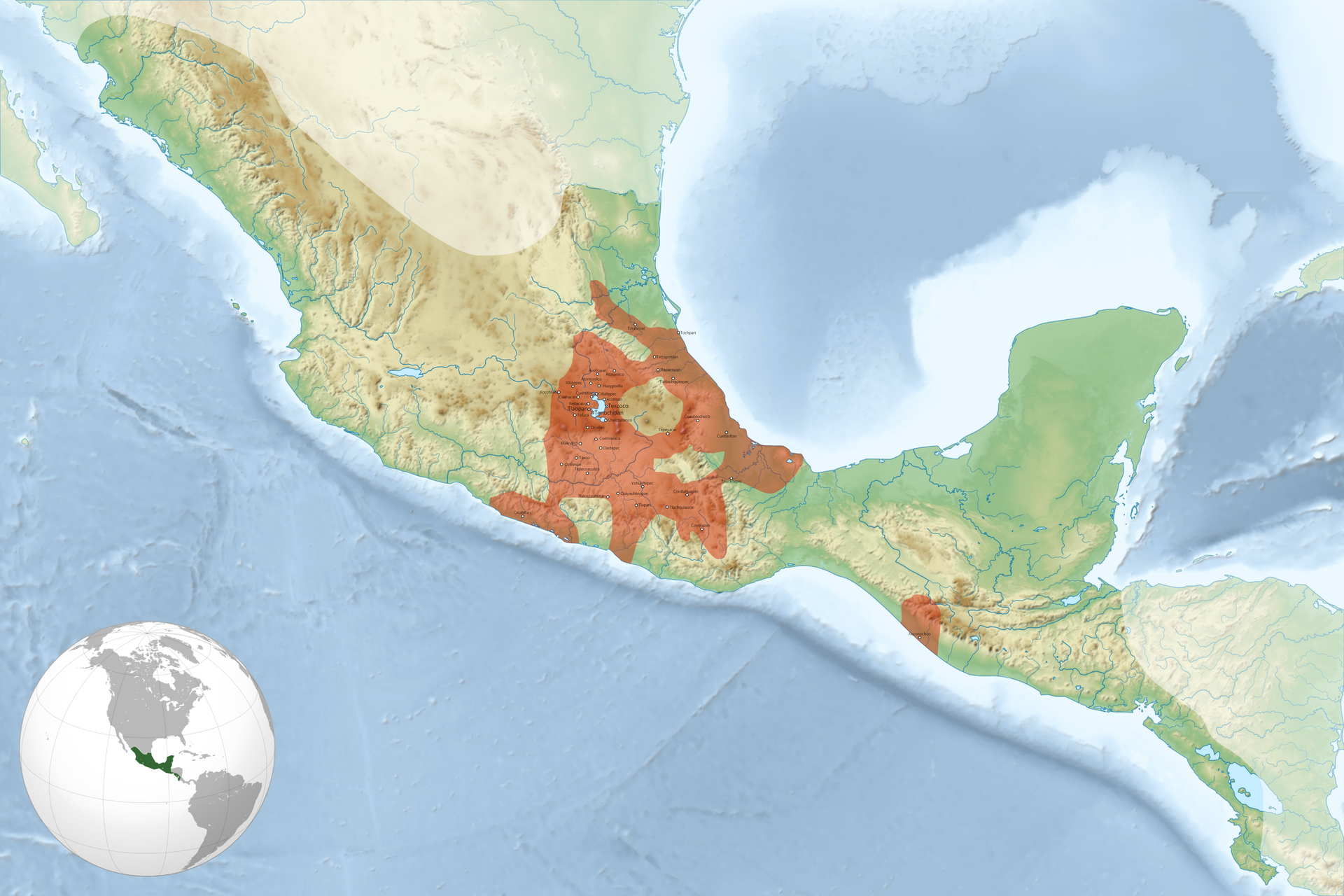
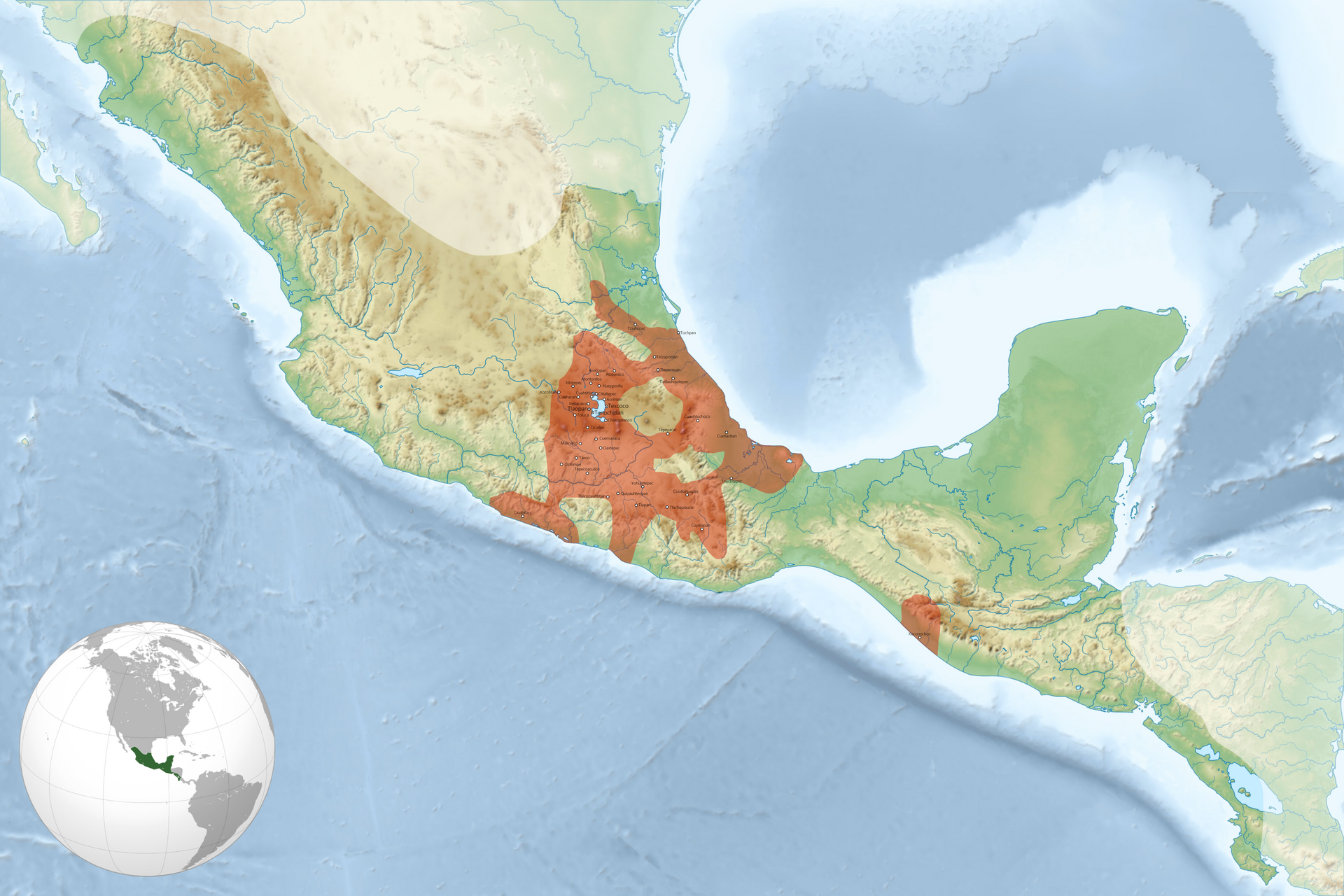
The Valley of Mexico into which the Mexica finally descended was not empty. It was a complex landscape of rival city-states clustered around a great inland lake, Lake Texcoco. The most powerful of these city-states in the early fourteenth century were Colhuacan to the south and Azcapotzalco to the west. The Mexica were latecomers, newcomers without land or allies. The dominant power of the region, the Tepanecs of Azcapotzalco, drove them from their first foothold at Chapultepec and executed most of their royal family. They were allowed to settle in a barren wasteland called Tizapan, where they gradually absorbed the culture of their Colhuacan neighbours and married into noble Colhuacan lineages. Through those marriages they acquired a connection to the legendary city of Tula, the great cultural touchstone of central Mexico. Then they were expelled again.
The island in the lake was unpromising by any measure. But the Mexica built on it with extraordinary energy. They expanded the natural islets by constructing chinampas, raised garden beds made by layering mud, vegetation, and sediment in the shallow water. These 'floating gardens' were extraordinarily productive, yielding multiple harvests a year. Over the following century, what had been a cluster of reed huts became a city of canals, causeways, and stone temples. The year 1325 is traditionally given as the founding date, and in 1376 the Mexica royal dynasty was formally established when Acamapichtli was elected as the first Huey Tlatoani, or great speaker, the title held by the ruler of Tenochtitlan.
For the first fifty years of the dynasty, the Mexica were tributaries of Azcapotzalco. They supplied their Tepanec overlords with warriors for conquest campaigns and received a share of the tribute in return. The arrangement was humiliating in status but useful in practice: it gave the Mexica military experience, a growing economy, and a slowly rising political profile. The ruler of Azcapotzalco during this period was a formidable expansionist named Tezozomoc, and the Mexica tlatoani Huitzilihhuitl cemented the relationship by marrying one of his daughters. The next tlatoani, Chimalpopoca, was Huitzilihhuitl's son and therefore Tezozomoc's grandson. The alliance held as long as Tezozomoc lived.
Tezozomoc died in 1426. His sons immediately fell to fighting over his throne. In the chaos, Chimalpopoca was killed, almost certainly by one of Tezozomoc's sons, a man named Maxtla, who saw the Mexica ruler as a rival. The Mexica elected a new tlatoani: Itzcoatl, Huitzilihhuitl's brother. Itzcoatl made a decision that would transform the Valley of Mexico. Rather than submit to Maxtla, he sought allies. He approached Nezahualcoyotl, the exiled ruler of Texcoco whose father Maxtla had also killed, and Totoquihuaztli, ruler of the Tepanec city of Tlacopan and Maxtla's own brother. Together these three city-states formed what history calls the Triple Alliance.
In 1428, the Triple Alliance besieged Azcapotzalco. The city fell. Maxtla was captured and sacrificed. Through that single campaign, the balance of power in the Valley of Mexico shifted entirely. Tenochtitlan became the dominant city-state in the region, and the alliance between Tenochtitlan, Texcoco, and Tlacopan became the engine of what we now call the Aztec Empire. Within the alliance, Texcoco and Tlacopan were quickly reduced to junior partners. Tenochtitlan and its Mexica rulers were the dominant force.
Itzcoatl pressed his advantage immediately. He conquered the city-states along the southern lake, including Xochimilco and Cuitlahuac, which brought the rich chinampa agriculture of those regions under Mexica control. He then pushed into the valley of Morelos, subjecting the city of Cuauhnahuac, the place known today as Cuernavaca. The Aztec Empire was not a single territorial state with garrison troops in every province. It was a hegemonic network. Conquered rulers were typically restored to their thrones; they paid taxes to the Mexica emperor, participated in imperial ceremonies, and provided warriors for further campaigns. The empire held itself together through marriage alliances, shared ideology, and the credible threat of force.
The political structure was consolidated by Itzcoatl's chief adviser, his brother Tlacaelel. Tlacaelel is credited with reforming Aztec society in ways that would define it for the rest of its existence. He strengthened the hereditary nobility, the pipiltin, and established legal codes that codified their privileges. He also, according to later accounts, ordered the burning of older historical manuscripts and the rewriting of Mexica history to emphasise their divine destiny and their connection to the ancient Toltec civilisation. Whether or not the burning of books actually happened as described, the effect of Tlacaelel's reforms was to give the Mexica a more exalted self-image and a more rigid social hierarchy.
Read full transcript (32 more paragraphs)
The next great ruler was Motecuzoma the First, elected in 1440. His name meant roughly 'he frowns like a lord, he shoots the sky', and his reign was one of aggressive expansion. He began, as new Mexica rulers traditionally did, with a coronation campaign to demonstrate military strength and reassert authority over any subject cities that had taken the change of ruler as an opportunity to stop paying taxes. When he requested labourers from the cities of the valley to help enlarge the Great Temple of Tenochtitlan, only the city of Chalco refused. That refusal led to a conflict that lasted until the 1450s.
Motecuzoma the First pushed the empire's reach far beyond the valley. He conquered the Huaxtec region of northern Veracruz, pushed into the Mixtec territory of Oaxaca, and extended Aztec power along the Gulf Coast. Three city-states, Tlaxcala, Cholula, and Huexotzinco, resisted incorporation and supplied warriors to the cities fighting against him. Against these three, Motecuzoma initiated a policy of low-intensity, ritualised conflict called the Flower War, the xochiyaoyotl in Nahuatl. These were not campaigns aimed at conquest but at the capture of warriors for sacrifice. Whether they were also a deliberate strategy to exhaust and weaken these resistant polities over time remains debated.
Motecuzoma the First also institutionalised the practice of human sacrifice on a scale that would become the defining image of Aztec civilisation in the European imagination. The Aztec religious worldview held that the sun required human blood to continue its daily journey across the sky. The gods had sacrificed themselves to create the world; humanity owed a debt of blood in return. Captive warriors, taken in battle precisely for this purpose, were the primary victims. The Great Temple of Tenochtitlan, the Templo Mayor, was both the physical and cosmological centre of this system: a stepped pyramid rising about fifty metres above the city, with twin shrines at its summit, one for Huitzilopochtli and one for Tlaloc, the rain god.
The Templo Mayor was not built once. Each new ruler added a layer, encasing the previous structure inside a new skin of stone, each addition requiring a new dedication ceremony. The temple excavated in the centre of modern Mexico City has been found to contain at least seven successive building phases. Around its base, archaeologists found the remains of dedicatory offerings: jade figurines, coral, obsidian blades, the bones of sacrificial victims, and the remains of animals brought from distant coasts. The Coyolxauhqui Stone, a massive carved disc showing the dismembered body of a moon goddess, was found at the foot of the main staircase in 1978. It was placed there deliberately: victims thrown down the stairs after sacrifice would land near her image.
The city that surrounded the temple was, by any measure, one of the great urban centres of the fifteenth-century world. Estimates of its population at its height range from roughly two hundred thousand to perhaps three hundred thousand, making it larger than any city in Europe at the time. It was built on an island and connected to the lakeshore by three great causeways, each wide enough for ten people to walk abreast. The centre of the city was the sacred precinct, a walled square containing the Great Temple, a ball court, a skull rack displaying the skulls of sacrificial victims, schools for noble children, and the houses of the warrior orders. Around this precinct the royal palaces of the tlatoanis spread outward, and beyond them the residential districts, the canals, the markets.
The great market of Tlatelolco, on the northern part of the island, was one of the wonders that the Spanish invaders would later describe with genuine awe. It was visited by tens of thousands of people every day. Every imaginable product of Mesoamerica was traded there: cacao, rubber, feathers, gold, cotton cloth, live animals, medicines, ceramics, and food of every kind. The Aztec economy ran on this market and on the flow of tribute goods from subject cities across the empire. Luxury goods, including the extraordinarily prized featherwork created by specialist craftsmen called the amanteca, flowed into Tenochtitlan from every direction. Feather mosaics, made from the plumage of tropical birds including the brilliant green quetzal, were used for ceremonial shields, cloaks, and headdresses.
The ruler Axayacatl, elected in 1469, inherited an empire at the height of its power and tested its limits. He incorporated the neighbouring Mexica city of Tlatelolco into Tenochtitlan's direct control, using his brother-in-law's alleged mistreatment of his sister as the pretext. He pushed conquests into Guerrero, the Puebla valley, and the Gulf Coast. Then he turned west, toward the one power in central Mexico that had consistently resisted Aztec expansion: the Tarascan state of Michoacan. In 1478 or 1479, he led a massive army westward, reportedly around thirty-two thousand men, against the Tarascans. They were ready for him. At a place called Tlaximaloyan, the Aztec force was routed. Axayacatl barely escaped back to Tenochtitlan with the remnants of his army. The Tarascans remained unconquered.
Axayacatl died in 1481 and was succeeded by his older brother Tizoc, whose reign became a lesson in the importance of military credibility to Aztec rulership. His coronation campaign against the Otomi of Metztitlan was a failure: he won only forty prisoners for his coronation sacrifice, a humiliatingly small number. Rebellions spread across the empire. Tizoc spent most of his short reign trying to hold what his predecessors had built. He died suddenly in 1485, and it was widely suspected that his own brother and war leader, Ahuitzotl, had him poisoned. Tizoc is remembered today mainly through the Stone of Tizoc, a massive carved disc decorated with images of his conquests, displayed as if to compensate in stone for what he had failed to achieve in battle.
Ahuitzotl, who followed Tizoc, was a different kind of ruler entirely. His coronation campaign was swift and decisive, suppressing rebellions in the Toluca Valley and making new conquests to the north. He then enlarged the Great Temple and in 1487 held the most celebrated dedication ceremony in Aztec history. The rulers of subject cities were invited to watch. Some accounts give a figure of over eighty thousand war captives sacrificed over four days. That figure is almost certainly a massive exaggeration, but even the most conservative estimates run to several thousand. Ahuitzotl also dealt with rebellion in Guerrero by ordering the entire population of two towns executed and replacing them with settlers from the valley of Mexico. His was a reign of both extraordinary construction and exemplary brutality.
Motecuzoma the Second, known to later history simply as Moctezuma, came to power after Ahuitzotl's death and continued the pace of expansion. He attacked the fortified city of Nopallan in Oaxaca, pushed conquests along both the Pacific and Gulf coasts, and reached as far south as the province of Xoconochco in Chiapas. He also intensified the Flower Wars against Tlaxcala and Huexotzinco, and tightened the social hierarchy at home, making it harder for commoners to rise into the nobility through military merit. He introduced a strict dress code limiting the kinds of luxury goods commoners could wear or consume. Moctezuma's Tenochtitlan was a city at the peak of its power, and a society increasingly stratified by birth.
In 1517, the first reports reached Moctezuma of strange ships sighted near the Gulf Coast. He sent messengers to investigate and ordered those living near the coast to keep him informed. Two years later, in 1519, the Spanish fleet commanded by Hernán Cortés landed on the Gulf Coast and began marching inland. Cortés was a Spanish conquistador, a military adventurer operating under the authority of the Spanish crown, and he was moving toward Tlaxcala, the city-state that had resisted Aztec power for generations. The Tlaxcalans, who had every reason to hate the Mexica, allied with him. So did several other central Mexican polities, including, eventually, Texcoco, Tenochtitlan's former partner in the Triple Alliance. Cortés arrived at the gates of Tenochtitlan not as a lone invader but at the head of a coalition army.
On the eighth of November 1519, Moctezuma met Cortés on the great southern causeway leading into the city. He invited the Spaniards and their allies to stay as guests in Tenochtitlan. What followed was a slow, strange paralysis. When Aztec warriors destroyed a Spanish camp on the Gulf Coast, Cortés demanded that Moctezuma execute the commanders responsible. Moctezuma complied. Power had shifted. The Spanish were effectively holding the Mexica ruler as a prisoner in his own palace, using him as a puppet to govern the empire on their behalf. As the Mexica population came to understand this, hostility toward the Spanish presence mounted.
In June 1520, the tension broke. A Spanish commander ordered a massacre of Mexica nobles gathered for a religious ceremony in the Great Temple precinct. The city erupted. During the fighting that followed, Moctezuma was killed. The Mexica accounts say the Spanish murdered him as they fled; the Spanish accounts say the Mexica stoned him as a traitor. The truth is buried under two competing narratives, each shaped by the shame of what it describes. What is certain is that on the night of the thirtieth of June 1520, the Spanish and their allies fought their way out of the city in a desperate retreat that the Spanish would later call the Noche Triste, the Night of Sorrow, losing hundreds of men and most of their equipment in the causeways and canals.
Moctezuma's kinsman Cuitlahuac succeeded as tlatoani and mounted a fierce defence of the city. But he ruled for only eighty days before dying, probably of smallpox, the disease that had arrived with the Europeans and was already tearing through the population of central Mexico. His successor was a young man named Cuauhtémoc, who would be the last independent tlatoani of the Mexica. Cuauhtémoc continued the defence with everything the city had. But the Aztecs were weakened by disease and encircled by enemies. Cortés returned with a rebuilt army, tens of thousands of Tlaxcalan and other allied warriors, and a fleet of small boats he had built to control the lake. The siege of Tenochtitlan lasted for months.
The city was destroyed block by block. The Spanish and their allies demolished buildings to fill in the canals, denying the Mexica the defensive advantage of the water. Starvation and disease did the rest. The population of one of the world's great cities was dying inside its own walls. On the thirteenth of August 1521, Cuauhtémoc was captured trying to escape across the lake by canoe. The Aztec Empire was over.
Cuauhtémoc's capture did not end his ordeal. According to Spanish accounts, on his surrender he asked Cortés to kill him immediately, calling it the honourable end for a warrior. Cortés refused and kept him as a captive. Later, when the treasure of Tenochtitlan proved smaller than the Spanish had hoped, Cortés had Cuauhtémoc tortured, his feet burned over hot coals, in an attempt to force him to reveal hidden gold. The gold was not found. Cuauhtémoc was forcibly converted to Christianity, renamed Fernando, stripped of his sovereignty though allowed to keep the title of tlatoani, and held under house arrest. In 1525, during an ill-fated Spanish expedition to Honduras, Cortés had him executed on a charge of treason. He was the last tlatoani to hold sovereign power through dynastic right.
With Cuauhtémoc gone and Tenochtitlan in ruins, the Spanish built Mexico City on top of the rubble. The lake was gradually drained and filled. The causeways became streets. The temple precinct became the site of a cathedral. The transformation was total and deliberate: a new city planted on the bones of the old to assert that a new order had replaced the one before it. The Aztec education system was abolished and replaced by limited church schooling. Aztec religious practice was declared idolatry and suppressed, replaced by Catholicism. Entire Nahua communities were placed under the encomienda system, a form of forced labour in which indigenous people were assigned to Spanish landowners.
The population collapse that followed the conquest was catastrophic. Smallpox had already struck Tenochtitlan during the siege. Further epidemics hit in 1545 and again in 1576. Estimates of the population of central Mexico before the conquest vary enormously, but even the most conservative calculations suggest that somewhere between fifty and ninety per cent of the indigenous population died within a century of European contact. Communities that had sustained themselves for generations were emptied. The Spanish policy of congregación, forced resettlement, gathered survivors from scattered villages into new towns where they could be more easily taxed, evangelised, and put to work.
Yet the Aztec political structure did not vanish entirely. The Spanish found it useful to govern through existing local structures. The altepetl, the Aztec city-state, became the basic unit of colonial administration, renamed the cabecera. Local indigenous nobles continued to function as intermediaries between the Spanish colonial government and the commoner population, collecting taxes and organising labour, now for new masters. The Mexica royal dynasty continued to govern the indigenous district of San Juan Tenochtitlan within Mexico City, though the rulers were increasingly puppets confirmed by Spanish authority. Between 1525 and 1538, the Spanish installed a series of non-dynastic administrators called cuauhtlatoani, a term meaning roughly 'one who speaks like an eagle', a category that had existed before the conquest to describe interim rulers without dynastic legitimacy.
Dynastic rulership was restored to Tenochtitlan in 1538, probably at the initiative of the Spanish viceroy Antonio de Mendoza, who calculated that a ruler with a legitimate Mexica pedigree would command more compliance from the indigenous population. The restored tlatoani, Huanitzin, was a grandnephew of Moctezuma, bilingual in Spanish and Nahuatl, and popular among the Nahua. This arrangement continued through several successors, but the last of them, Cipac, who ruled from 1563 to 1565, fell into repeated conflicts with Spanish authorities over taxation and legal jurisdiction. The stress of those conflicts contributed to his early death, and the Spanish used his passing as the occasion to end dynastic indigenous rulership entirely, replacing it with Spanish-appointed governorships.
To understand what was lost in 1521, it helps to stand inside what the Aztecs actually created. Their city Tenochtitlan was an engineering achievement built on water, sustained by the chinampas and fed by a stone aqueduct carrying fresh water from the mainland. Their calendar system, inherited from earlier Mesoamerican civilisations and refined, interlocked a ritual cycle of two hundred and sixty days with a solar year of three hundred and sixty-five days, producing a fifty-two year grand cycle that governed religious observance across the entire empire. Their writing system combined pictographic images with phonetic syllable signs, allowing them to record the sounds of names and places even if it never developed into a fully alphabetic script.
Aztec poetry was a sophisticated literary tradition with its own genres and formal conventions. Song and poetry competitions were held at major festivals. The Nahuatl word for poetry was 'in xochitl in cuicatl', meaning 'the flower, the song', a paired metaphor expressing the duality that ran through all Aztec artistic thought. Some of this poetry survives, collected by Spanish friars and indigenous scribes in the decades after the conquest. Some poems are attributed to specific authors, including Nezahualcoyotl, the tlatoani of Texcoco, who was also a philosopher and architect. Whether those attributions are accurate is uncertain, but the poems themselves are real, and they carry the recognisable voice of a civilisation thinking hard about mortality, beauty, and the obligations of the living to the dead.
Aztec sculpture produced some of the most remarkable objects in the history of Mesoamerican art. In 1790, workers digging in the main square of Mexico City, the Zócalo, unearthed two massive stone sculptures that had been buried immediately after the conquest. One was the famous calendar stone, a circular disc carved with cosmological imagery that has since become the most reproduced symbol of pre-Hispanic Mexico. The other was a towering statue of the earth goddess Coatlicue, nearly three metres tall, her skirt made of writhing rattlesnakes. Both had been painted in vivid colour when they stood in the ceremonial precinct. What we see in museums today, bare grey stone, is only the skeleton of what the Aztecs saw.
The Spanish colonial project tried to erase Aztec civilisation from the landscape, burning codices, demolishing temples, and suppressing religious practice. But Nahuatl survived. It is still spoken by about one and a half million people, mostly in the mountainous states of central Mexico. More than that, Nahuatl words passed into Mexican Spanish and then into global languages. Chocolate, tomato, avocado, chilli, tamale: these are all Nahuatl words, carried outward from the markets of Tenochtitlan through the Spanish trade networks and eventually into every kitchen in the world. The culinary legacy of the Aztecs has a genuinely global reach, even if few people who eat a tomato or drink a cup of hot chocolate know where those words came from.
When Mexico achieved independence from Spain in 1821, the new nation needed symbols that were distinctly its own, separate from the European identity of its former colonial rulers. The Aztecs provided them. The eagle devouring a serpent on a cactus, the founding vision of Tenochtitlan, became the centrepiece of the Mexican flag and national coat of arms. It appears on official buildings, state seals, and currency. The Aztec past was consciously recruited into the project of building a Mexican national identity, though the relationship was never simple. Conservative elites often celebrated the ancient Aztecs while remaining hostile to the living indigenous populations who were their descendants.
This tension ran through Mexican political and intellectual life across the nineteenth century. Liberal politicians like Benito Juárez, a Zapotec who became Mexico's first president of indigenous origin, and Nahua intellectual Ignacio Altamirano used the indigenous past as a resource for arguments about equality and national dignity. Under the long presidency of Porfirio Díaz, who dominated Mexico from 1876 to 1911, the government funded archaeological research and protected ancient monuments while undermining the rights of living indigenous communities. A monument to Cuauhtémoc was placed on the Paseo de la Reforma, Mexico City's grand boulevard, inaugurated in 1887. The last tlatoani was honoured in stone while his descendants worked under conditions the colonial system had built.
The Mexican Revolution of 1910 to 1920 changed the terms of the relationship between the Mexican state and its indigenous past. Mass participation by indigenous people in the revolutionary struggle gave new urgency to the question of what Mexico owed its pre-Hispanic heritage. The movement known as indigenismo, a government-sponsored embrace of indigenous culture as a source of national pride, produced some of the most vivid public art in Mexican history. Diego Rivera, the great muralist, painted vast scenes from Aztec history across the walls of public buildings in Mexico City, making the Mexica past visible to millions of Mexicans who had never set foot in a museum.
The Aztec archaeological record continued to yield extraordinary finds. The excavation of the Templo Mayor, begun in earnest in 1978 after the accidental discovery of the Coyolxauhqui Stone during utility works, revealed layer after layer of the ceremonial heart of Tenochtitlan beneath the streets of modern Mexico City. The museum built beside the excavation site now holds thousands of objects from the dedicatory offerings buried within the temple's successive building phases: jade masks, obsidian figures, coral, the bones of sacrificed animals and humans, objects brought from every corner of the empire as offerings to the gods who lived at the centre of the world.
Mexican writers and intellectuals have continued to wrestle with what the Aztec legacy means. The poet and essayist Octavio Paz critiqued the way the Mexican state appropriated Aztec symbolism for nationalist purposes, arguing that the layout of the National Museum of Anthropology in Mexico City constructs a view of Mexican history as if it all culminated with the Aztecs, projecting a nationalist ideology backwards onto the pre-Hispanic past. Yet Paz himself, like many of the writers who made the same critique, drew on Aztec imagery and mythology in his own work. The Aztecs are too deeply embedded in the symbolic vocabulary of Mexican culture to be set aside, even by those who are suspicious of how they are used.
The Florentine Codex, the great encyclopaedic record of Aztec culture compiled by the Franciscan friar Bernardino de Sahagún and his indigenous collaborators between 1545 and 1576, runs to twelve volumes and covers religion, calendrics, botany, zoology, history, and the account of the conquest from the Mexica point of view. It was produced in both Spanish and Nahuatl, with indigenous scribes trained in alphabetic writing recording the knowledge of their own civilisation for a colonial authority that was simultaneously destroying it. The codex is the most complete record we have of how the Aztecs understood themselves, and it was compiled within living memory of Tenochtitlan's fall.
The knowledge encoded in that document and in the other codices, annals, and accounts that survived the conquest has sustained five centuries of scholarship. Aztec archaeological sites are excavated and opened to the public across Mexico. The Nahuatl language is still taught and spoken. In the 2020 United States census, Aztec was listed as one of the example categories for American Indian identity, and it became the largest single American Indian identity that respondents claimed. The people the Spanish tried to eradicate in a generation have proved considerably more durable than the Spanish expected.
What the Aztecs built was, in the end, not simply an empire or a religion or a city, though they built all three on a remarkable scale. They built a way of understanding the relationship between human beings and the cosmos: a system in which the sun required blood to rise each morning, in which poetry and warfare were both forms of tribute to the gods, in which a city built on a swampy island in a mountain lake could become the centre of the world. That world was destroyed in 1521. But the eagle on the cactus is still on the flag, the words for tomato and chocolate are still in the mouth of anyone who speaks English or Spanish or dozens of other languages, and the stones of the Templo Mayor still lie beneath the streets of one of the largest cities on earth, waiting to be found.


